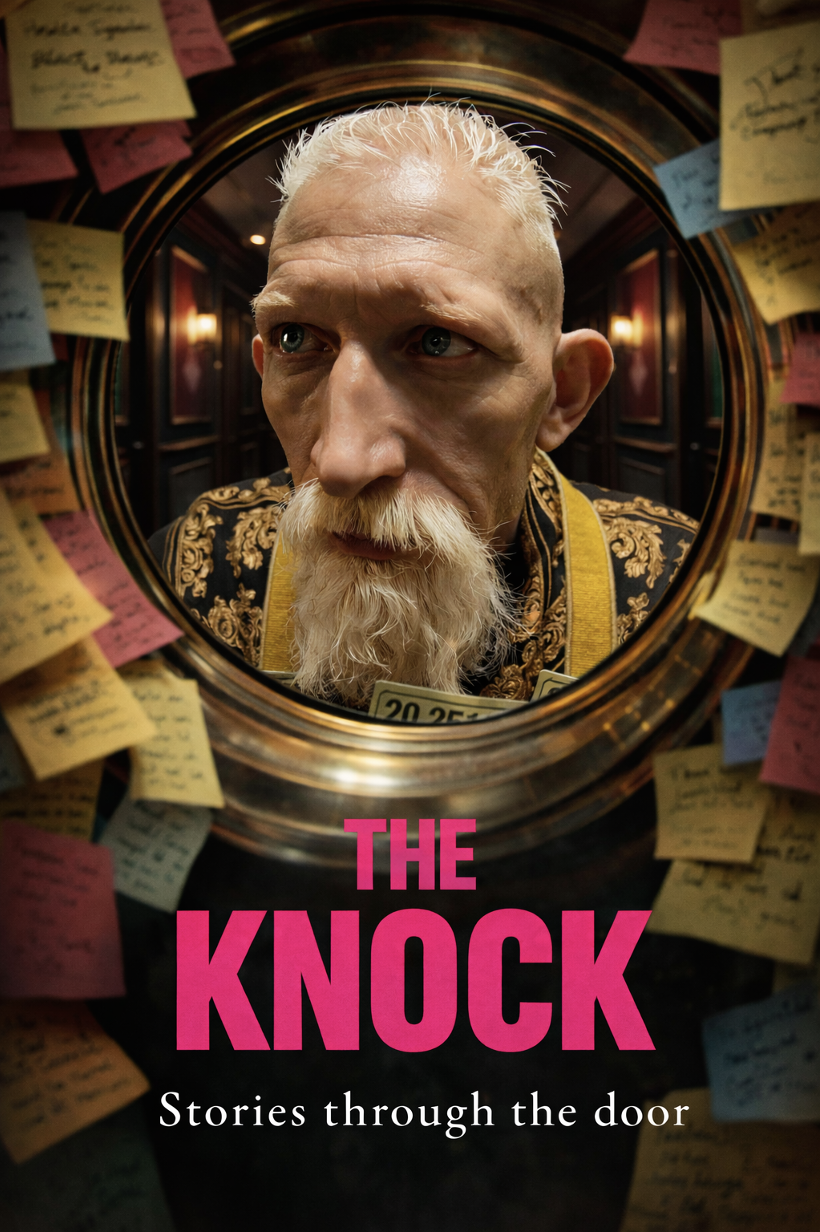
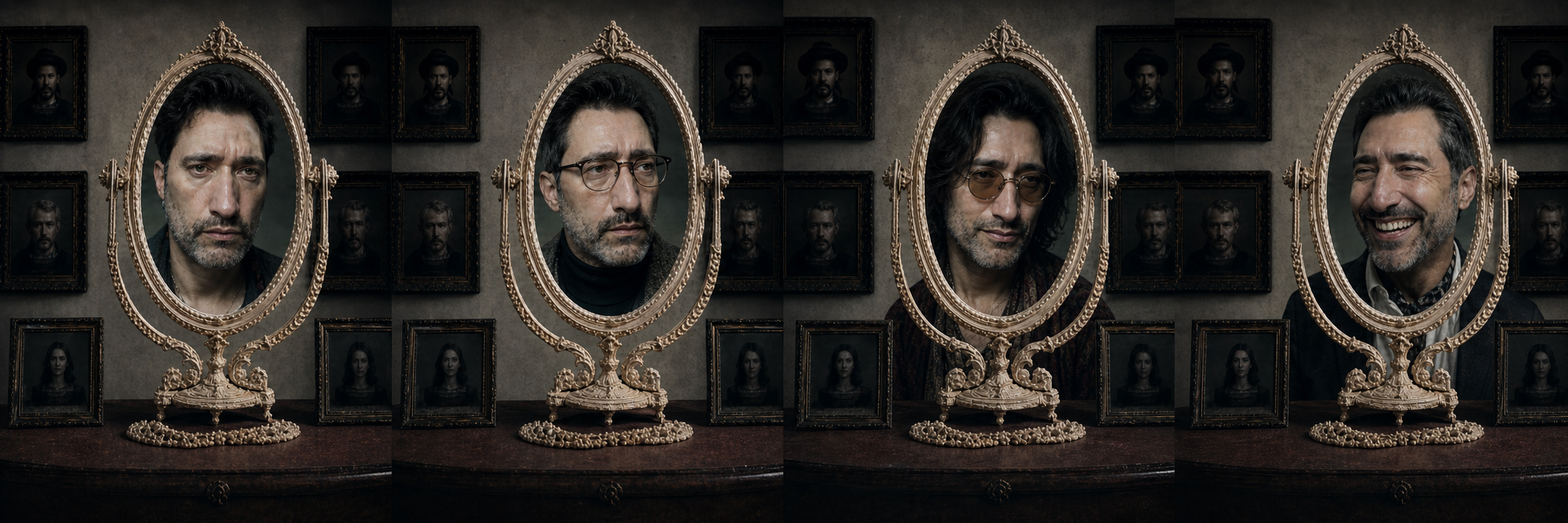
Notes from the periphery... process jottings from a painter venturing out of his lane.
Caleb Weintraub
Generated clip. The artist, caught in the act. March 2023.
Trespasser's Log is a series of process documents. Each entry takes apart a creative project I built using AI tools. Tools that let me work in disciplines in which I was never trained. I am a painter. These projects involve music, fiction, programming, product design, and fragrance, among other things. The entries describe what I made, how I built it, and what I think about it. They are not tutorials. They are not manifestos. They are notes from someone who stepped into unfamiliar territory and grew familiar with it by working there.
The first entry, below, is about The Knock... a piece of interactive fiction experienced on a computer. The premise: the occupant is locked inside a hotel room. People come to the door. Conversations take place through a peephole. The people are characters in a story. Fourteen of them, each with a voice, a history, and secrets they may or may not share. The conversations become chapters of a novel. No two users receive the same book.
🐴 The Horse's Mouth — a preamble
"How old are you?" 300,000... hang on... 13.8 billion.
Lucas Samaras gave a version of that answer in 1971, in an interview with himself. Asked his age, he answered, "Nineteen hundred and seventy-one." I encountered that reply as a child, before I had opinions about authorship or inheritance. I understood it though. We are the sum of what came before us.
That seems obvious until ownership enters the room.
Painting is framed as a solo effort. It is not. Every canvas depends on people who brought the materials into being. Pigments dug from the ground, milled, bound, packaged, shipped. Substrates engineered, stretched, woven, primed, cut, sold. The tools carry other people's labor and other people's decisions. The painter stands in front of the canvas and becomes the visible point of concentration, and we mistake that concentration for the origin. The origin is scattered. The work is a convergence before the first mark is made.
Ideas behave the same way. Absorbed, remembered, misremembered, revised, damaged, repeated, regurgitated. Some arrive through study. Some arrive through accident. Some arrive through language that was already in the offing before I knew I had picked it up.
AI did not invent this condition. It made it harder to ignore.
We are accidents of loci, barely contained in one organism. Temporary concentrations of matter, memory, labor, accident, and location.
So I do not hold tight to the title of author or master or owner of the things documented here. Paintings, routed foam, code, voice tests, interface decisions, character fragments, prompts, failures, edits -- they belong to a current as much as they belong to me. I steer occasionally. I choose. I resist. I redirect. I do not pretend the current began with me.
I choose to be unmoored.
A Log About the Log
Scholars, critics, aesthetes, and other professional explainers have a habit of imagining what people who tickle canvas, tinker with machines, or build strange little systems think they are doing. This log preempts some of that.
You did not ask me to tell you. But I am telling you.
The experiences, the apps, the things that can be used and consumed -- those are the spoils, the evidence, the artifacts. They may not be for everyone. They ask a lot. They take time and they require the manufacturing of interest in nonexistent places, with made-up events and made-up people. But in case you are curious, not about the specimens but about the hunt, these are my notes from the periphery.
The log is a little diaristic -- but only a little. Occasionally technical -- but not enough to accidentally educate. A tad editorial -- but with only moderate delusions of persuading the reader. In an effort not to lose the reader entirely, and with the hope of communicating the way I typically communicate, by speaking and pointing and pulling up links and emptying my pockets, this effort takes the formless form of writings and videos and images and other interruptions. There are buttons for pressing and hyperlinks to activate. Sometimes words won't do.
Entry 1: Building The Knock
April 10, 2026
Painting and sometimes language are my primary means of organizing my thoughts, of navigating the world around me. Over the past few years a host of tools surfaced -- language models, image generators, audio processors, among others. A hole opened in the fence. I went through.
One rule I have for these venturings. If the excursions are to count for anything, I have to come back with something. Not a hypothetical. Not an aspiration or a description. An object. A thing. An experience that could be... experienced. This tenet, demanding an artifact of one kind or another, leads to a good deal of sleeplessness. There is quicksand everywhere. And where there is a will there is a... workload. But I have the capacity to obsess. I can do the work. I like the work. It does not feel like work. It feels like hacking through thistle with a sharp-enough machete. Occasionally being overwhelmed and tangled, but mostly finding a way through. Lacking means. Relying on elbow grease and body english.
I used to write made-up aphorisms -- maybe they were maxims -- on the walls of my studio. One of them was "Be the finisher." A hedge against a tendency to encounter an impasse and jump ship, a failure not of volition but of stamina. The sign would remind me to stay the course.
Even with the artifact in hand though, the element that can be seen and heard and smelled and consumed, even then there is room for finishing. As it turns out, it is thistles all the way down. I will chase a truck on its way to the gallery to add another brushstroke, a final dab. I nurse fantasies, counterfactuals about what it might be like if this had a bit more that, or that had a bit less of this. Willie Pep, the featherweight, won over two hundred fights and very few of them by knockout. He won on points. Round after round, the scorecard accumulating in his favor. I went the distance. I came back with the thing. Ready for the ring... even if it is only finished-ish.
That was how I thought about the game. It has a link. Anyone can go to it.
But working on it has shifted the terms. A game with no win state, a novel with an unstable narrative, a play with a shifting cast (hinting that all users are different) may not satisfy all expectations... but the same could be said for any painting. I make paintings at least as much for the experience of making as for the hope that they will stick a landing and prove engaging.
I thought I was coming back with the game.
It turns out I was coming back with the making.
The locus of art-practice, in light of all these developments, is starting to shift -- from product to experience, or more honestly for what I am doing, to process. Painters and other makers have known some version of this for a long time. What is different now is that the shift is happening inside the work itself.
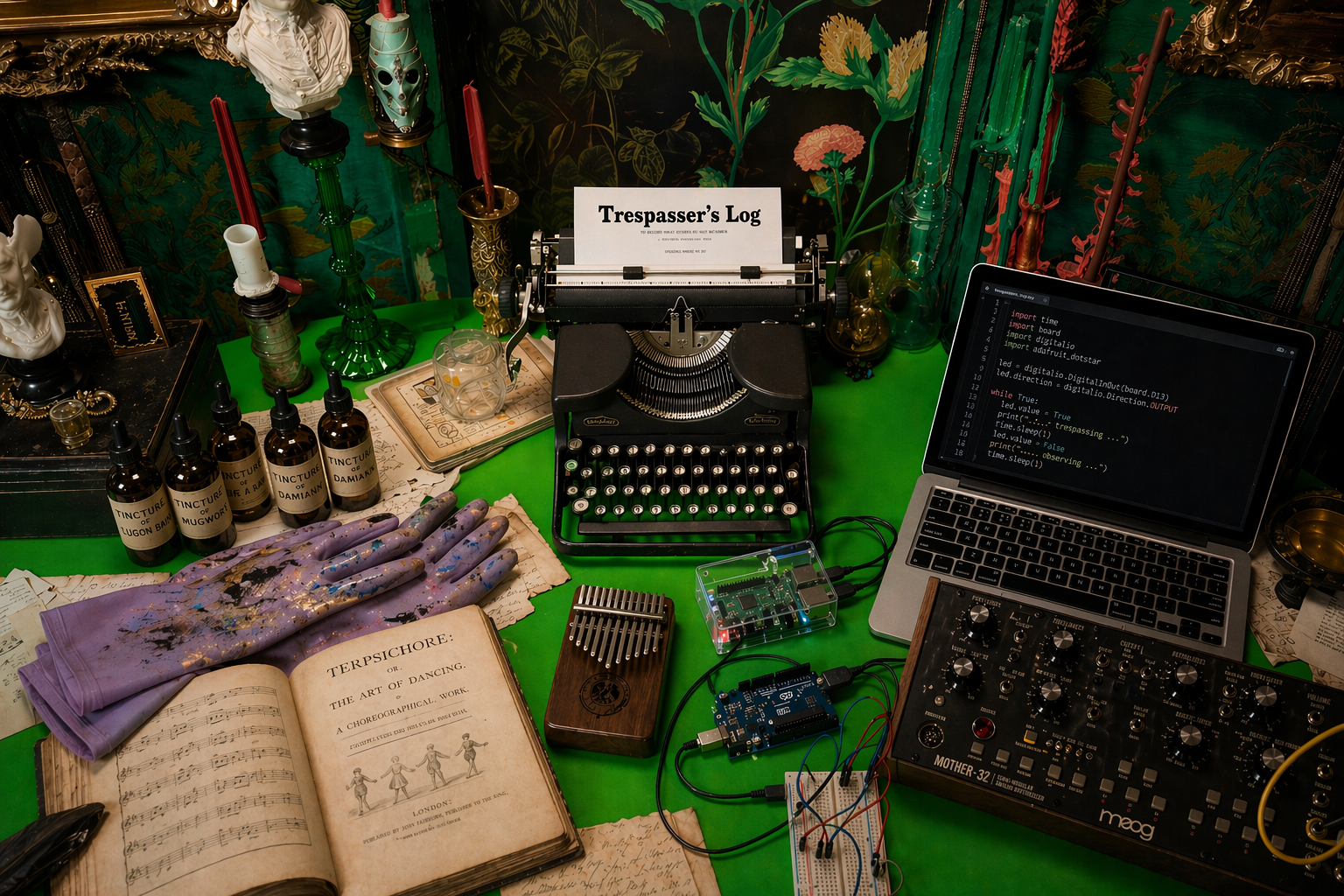
Kalimba, DFAM, choreography manual, tinctures, odds and ends. Heavily altered for color and effect.
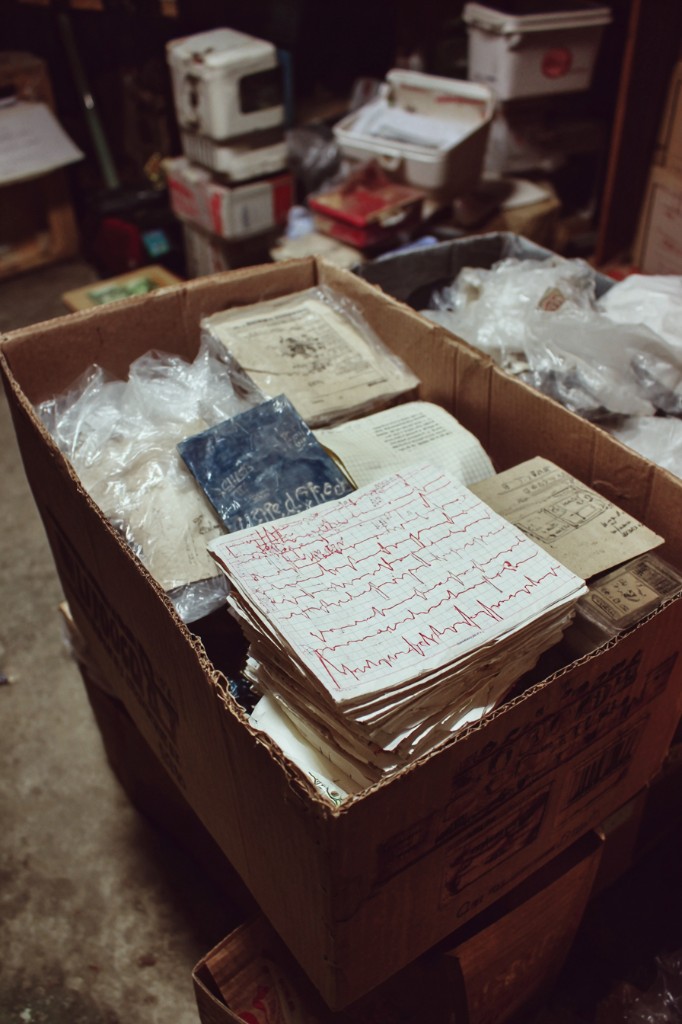
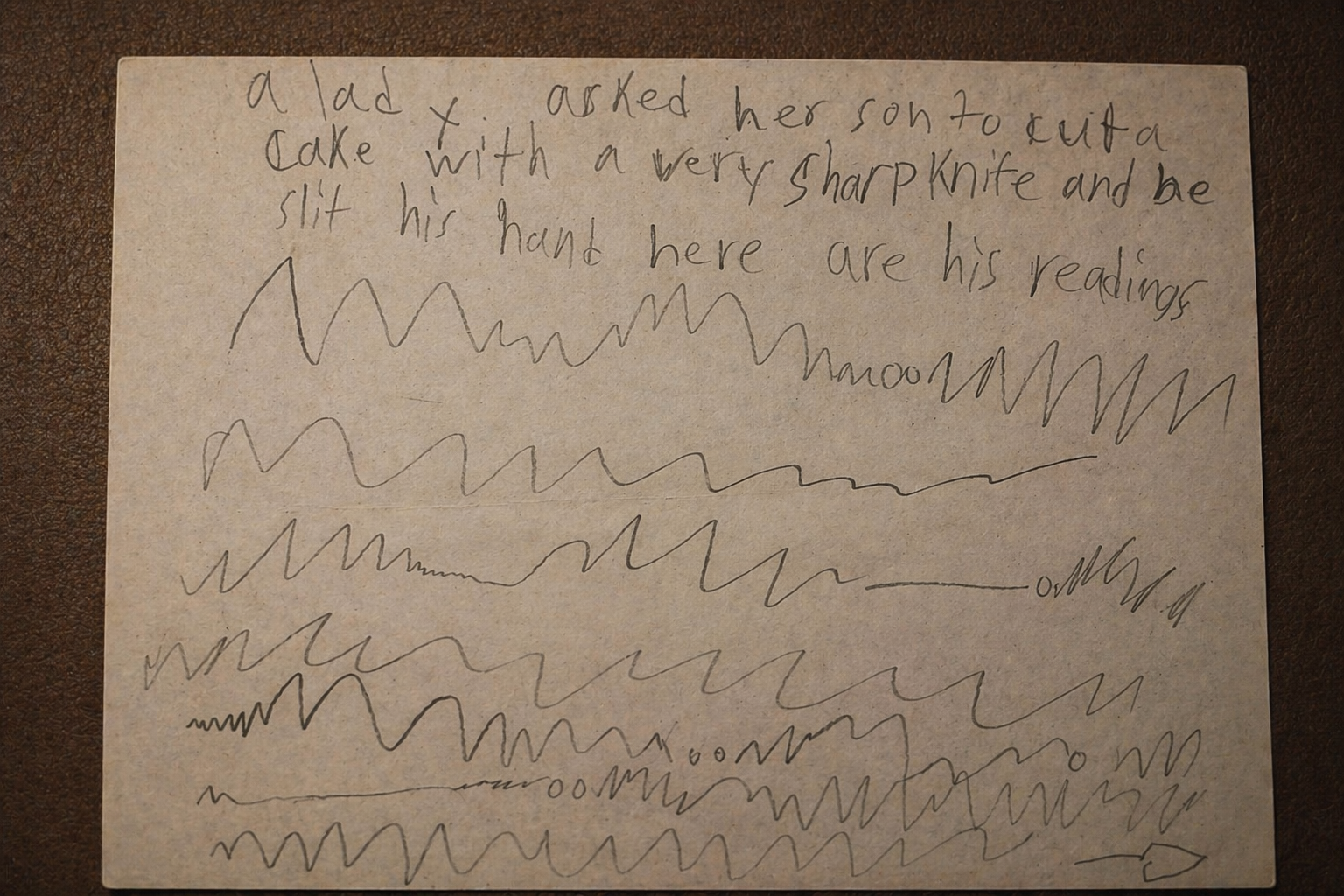
I came across a box in the basement. Hundreds of pages of what looked like EKG lines, methodically drawn in graphite on typewriter paper. Leafing through the stack I found medical charts bearing the somewhat unlikely names "Sam Lampert" and "Vanessa Rug." References to hearts and "kid nees." Photocopied textbook pages with seemingly only prepositions left unhighlighted. Newspapers with headlines warning about such fearsome threats as a rise in "new moan ya" and an underreported uptick in cases of phantom limb syndrome. Intake documents. Transcribed notes from concerned doctors, including the perhaps too aptly christened "Dr. Deloris Carer." And tucked near the bottom, a mournful page or two of flatlines and a note about the patient. Either the chart was incomplete or this was indeed a very rare case of "terminal claustrafibula." But looking through it all I could hear it again -- the ringing of a cradle phone, the beeps of machines either imagined or rigged up from a record skipping upstairs, respirating, sounding uncannily like the whirring and beeping of a hospital room.
Basement boxes.
These were the detritus of serious play.
A patient's readings.
My sister and I were committed. Roles, props, documentation. In order to cross into another world, the sensory apparatus had to be constructed. The signifiers had to feel real. A hospital needed charts, prescription scripts, ringing phones, the hum of machines. If the props were wrong, the fiction would unravel.
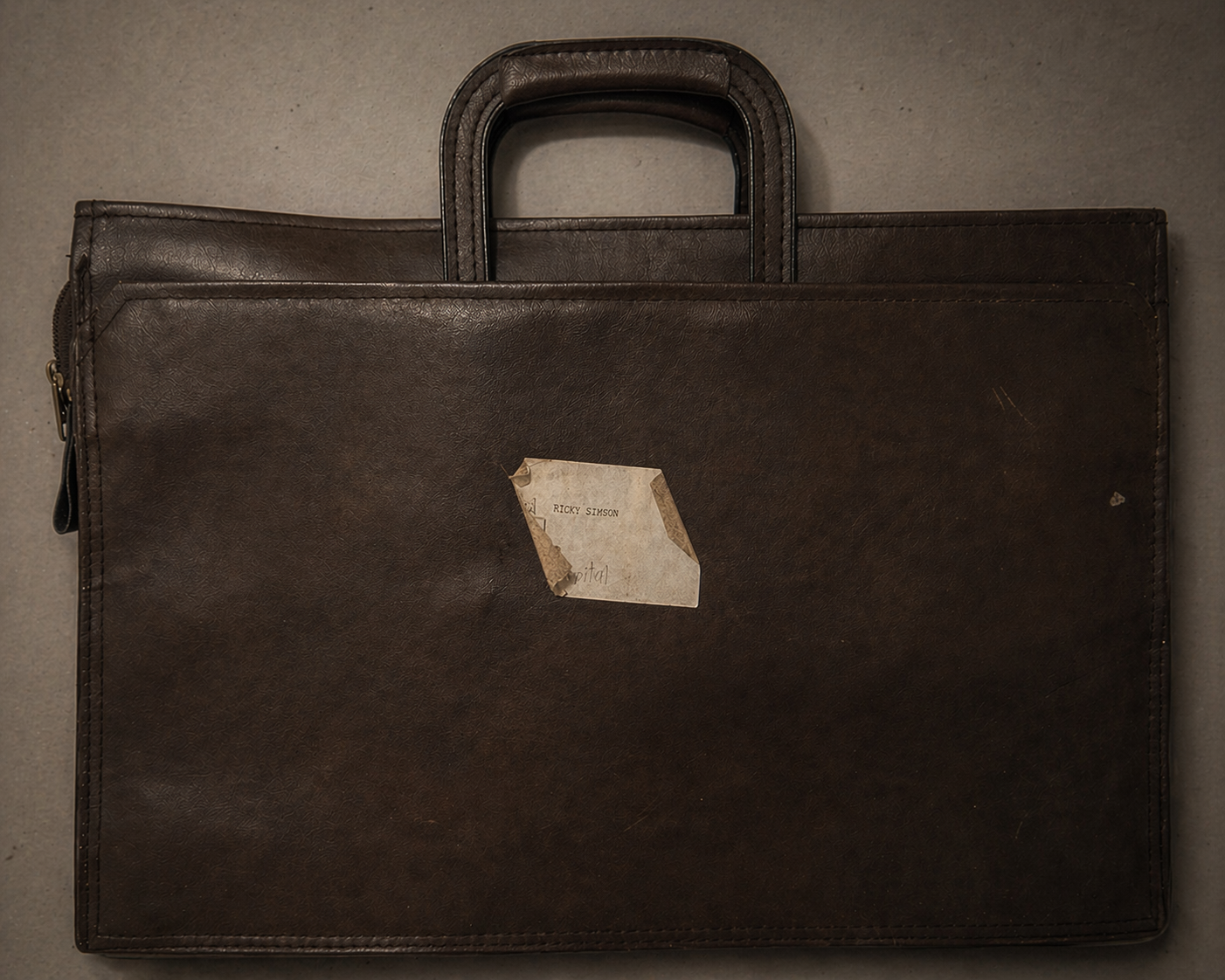
Dr. "Ricky Simson's" briefcase.
My grandparents ran a PR business out of their house in Maywood, New Jersey. The office was connected to the home. From a certain point of view, it had everything one would need to keep a hospital up and running. Paper. Staplers. Phones with hold buttons. Intercoms. Typewriters. Carbon paper. Rubber stamps. White-out. Manila envelopes.
Those same supplies, rearranged, proved capable of stocking a restaurant. A newsroom. A detective agency. A veritable rocket ship. The setting transformed depending on the season, the mood, the available cast. During holidays, the cast expanded. The hospital became a courtroom. Children became defendants and prosecutors. Grandparents transformed into judges. Cousins turned into witnesses. Aunts and uncles reconfigured into opposing counsel. Everyone played a role. Everyone played along. Adults abandoned their concerns for suspended moments and inhabited roles that the children had authored. The hierarchy inverted and something emerged that could not have existed in either world alone.
Someone brought a gavel and a gown. There were folders filled with photographs -- scenes of a crime. There were eye-witness testimonies. I seem to recall a long and gnarly stick. If memory serves it was presented as key evidence, maybe even the murder weapon itself? One year there was a giant brass key. Someone showed up in full police uniform. I wore my grandfather's suit jacket. I do not believe it improved my verdict.
For most, it ended when the holiday ended. For one suspect -- or was I an attorney? -- it did not.
What lingered was a fascination with narratives that put the participant at the center of the story. Fictions sustained by physical objects that shatter the membrane between the world of the narrative and the world of the senses. Narratives that invite the player to travel in time or locale through the bite of a sugar cube, the taste of a strange tea, the beep of an intercom, the scratch of a line across an EKG. Artifact as talisman -- as container of larger and more layered ideas than any single sentence can hold. Religious relics. Ritual objects that bridge the spirit and the sensory. Narratives that do not demand passivity.
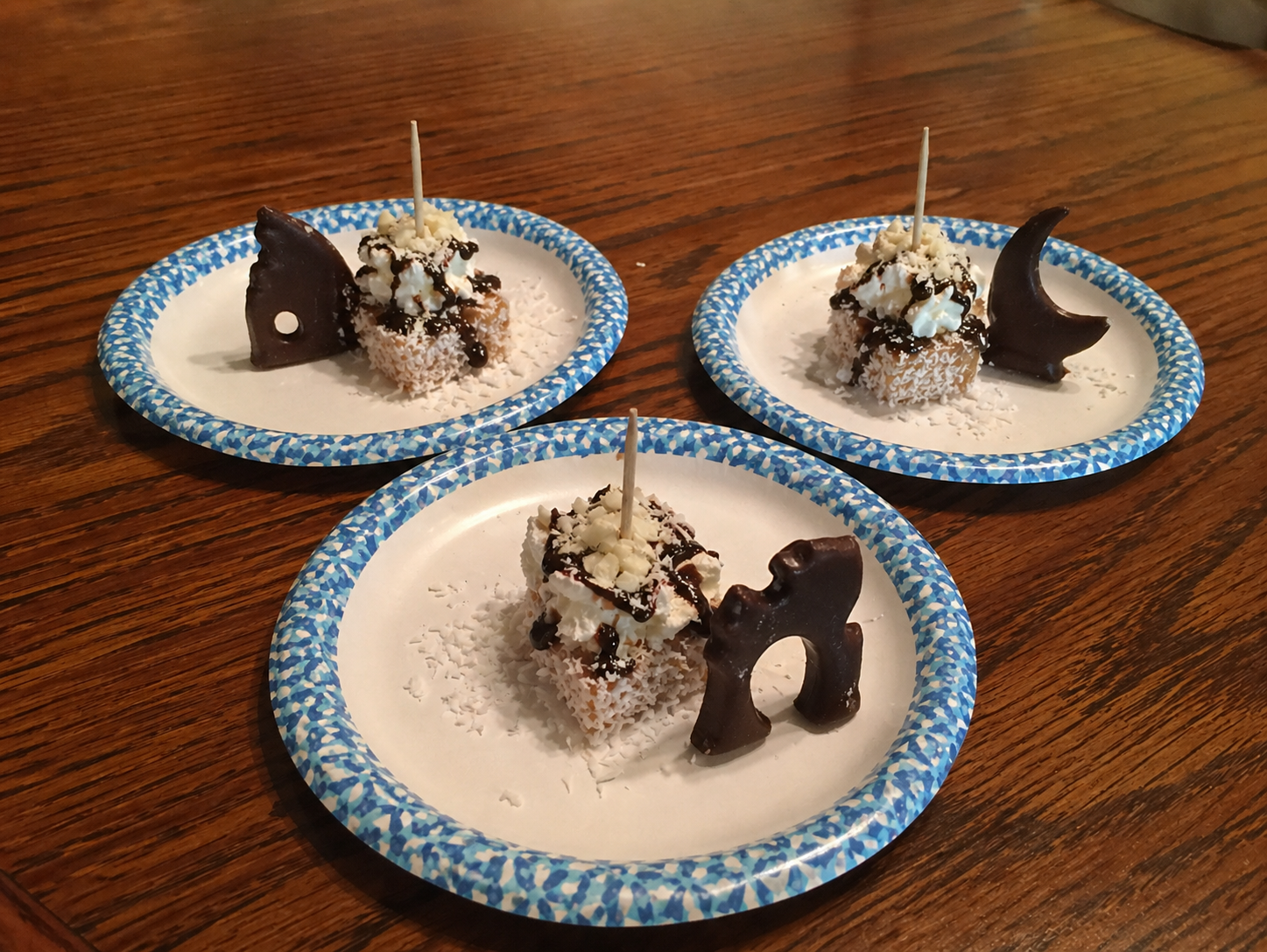
Turkish delight, coconut shavings, pantry odds -- made unrecognizable through modest if messy efforts to match the day's story.
Years later, as an adult, when my children were young, I told them stories we referred to as dessert stories. The premise was always the same. Three boys owned a dessert shop. Their nemeses -- characters with nearly identical names -- ran a rival operation across the street. The stories were silly and mindless and meant for six- and seven- and eight-year-olds, but each one followed the same arc: the expert bakers would travel far and wide searching for the finest ingredients to construct their exotic confections before this or that bake-off. They dodged sabotage. They bartered with hermits for jars of fossilized honeycomb. And always, inevitably, they stuck the landing, served their desserts, and won. The trick was that I had made the dessert before the story started -- concocted it, hidden it -- so that the ingredients described in the tale would match the thing I placed in front of them when the story ended. The cubes of magical tree sap coated in the dust of unicorn wings were Turkish delight -- somewhat exotic in its own right where we lived -- sliced and dusted in powdered sugar to appear just like the confection described in the tale. The layers of crushed alpine hazelnuts bound in caramelized mountain butter were, for all intents and purposes, a Twix bar transmogrified beyond recognition through Nutella and a bread knife. By introducing elements from the story onto our table, into our hands, the membrane thinned.
I am primarily a painter. Usually oil and acrylic on canvas... sometimes on wood or on carved surfaces. I like getting my hands dirty. I literally paint with my fingers half the time. I draw a lot. I scribble. Even when I am walking around I am usually painting in my head... thinking about color, thinking about how shapes interact or do not. Imagining how this or that tree could be described. Or blurring my eyes until everything out there is just light and pattern. This is how I see the world. How I choose to see the world. For the most part.
With the surfacing of these new tools, the office supplies were back. The typewriter. The rubber stamps. The phone with the hold button. I could trespass into territories for which I had no credentials. Clothing design. Product design. Film. Programming. Language work. Fragrance. Music composition.
I think of art more as lab than as courtroom. Labs are for testing. Not for policy. Not for ideology. We try things. We observe what happens. We write it down. This document is the writing-down part.
One rule I have tried to hold myself to: trespassing does not count as practice if it does not result in something tangible. Something experiential. A working prototype. An object we can hold or an experience we can walk through. We are in an era in which too much stays hypothetical -- a pitch deck with no product behind it. If the work does not eventually become real, I am not sure it was work.
What follows is a look under the hood of one of these trespasses. I plan to document the others over time -- the process, the tools, the rationale. Less to prescribe an approach than to organize the thinking. They all started with me going somewhere I did not belong.
Introduction. The Knock. What this is and why it exists.
The Knock
The occupant is inside Room 412 of the Mane Nobiscum (MAH-neh noh-BIS-koom) hotel. The door is locked. The occupant cannot remember how they got there. The owner died six months ago. Heart attack, they said. No one believes it. People keep coming to the door. The occupant stands at the door, looks out through the peephole into the hallway, and sees them. They speak through the wood. The occupant speaks back.
What they say may or may not be true.
Wire. Long-time resident. Room 614.
This is The Knock. Not a game. Not a chatbot. Not a branching narrative. No puzzles. No correct paths. No win states. No score. The encounter is its own point. The user decides which questions to ask, which answers to believe, and which contradictions to pursue. Meaning is constructed, not discovered. Somewhere between a novel, a play, a mystery, a dream, and a communion.
The territory is familiar even if the form is not. Rashomon's unreliable witnesses. Pale Fire's contaminated knowledge. Studs Terkel's principle that something forms in the listening that was not there before.
Live interaction through the peephole.
The Peephole as Epistemology
The peephole is the fiction. Interface and thesis. The choice of interface -- a warped fish-eye view rather than a full-body conversation -- was partly practical. The animation at this stage does not extend to bodies, and the latency of the technology sometimes requires the video to appear in lower resolution. The peephole is, in that sense, a smoke screen. But narratively I settled on it for a different reason. Its habit of distorting and warping and delivering friction underscores the lack of clarity one experiences on entering the story -- meeting characters who occasionally deliver conflicting messages and cannot always give a clear picture.
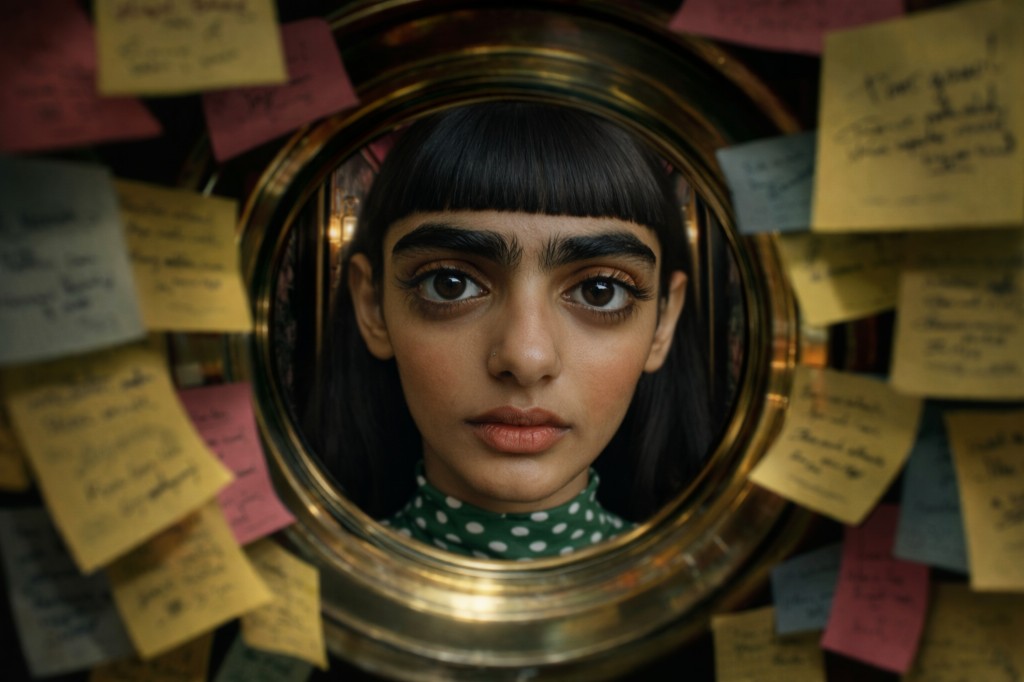
Fish-eye distortion. Brass vignette. Darkened edges. The distortion is not cosmetic. It enacts the condition of looking without seeing clearly. Before anyone speaks, the frame telegraphs that we may not get the full picture. Not in this interaction. Not in any.
The peephole performs partial knowledge. You lean toward the door. You still do not know.
The visual stack is five layers deep. A hallway background. A walkup transition for each character. The character's face, composited live and framed by the peephole. A brass overlay. A vignette layer. All of it running in real time in the browser.
The voice comes through the door with no distortion. The image is compromised. The asymmetry invites us to listen more closely than to look.
Anticipated vs. Prepared
In choose-your-own-adventure books, branching games, and other interactive formats -- entertaining in their own right -- the experience is preconceived. The author has anticipated the reader. Every choice leads to pre-written content. The tree is finite, and freedom means picking from options someone else already drafted.
Here, the author has prepared for the user instead of anticipating the user. The author lays out the range of what a character might say, what they know, what they will not reveal, how they sound when pushed. The user then speaks freely, and the system answers from within those conditions. The shape of the conversation is unscripted. The pressure that gives it its shape is not.
Janet Murray called this procedural authorship. The difference is between painting every frame of a falling apple and defining the gravity, so the apple falls correctly no matter how the user throws it. I am not writing every possible conversation. I am writing the character thoroughly enough that the system can have any conversation as that character.
The parameters are authored, but the verbal framing -- the words themselves -- is not predetermined.
Character Architecture: Wire
Fourteen characters. Each character prompt defines persona, voice, knowledge, secrets, wants, kernels (the specific facts a character can divulge), and guardrails. The constraint files total over 2,200 lines of authored direction.
To give a sense of what that looks like in practice, consider one of the hotel's guests.
Wire is a long-time resident. Māori-Pākehā (mixed Māori and European heritage). Looks mid-forties with a weathered face and a white-blonde beard that reaches his chest. Patterned robe, oranges and blacks, paisleys. He has been in Room 614 longer than anyone can account for. Something ancient about him that people sense but cannot name. He speaks with NZ Māori cadence, weaves in te reo phrases, reaches for horse racing idioms when other people would reach for small talk. He is not staff. He is not exactly a guest. He is the building's memory in human form.
Excerpts from Wire's Voice Constraints
"You speak slowly. Unhurried. Conversations are races, and you are the one who watches from the rail, not the one riding."
"You drop articles sometimes: 'Been here long time.' 'Building knows.' You refer to the hotel as 'she' or 'the old girl.'"
"Your references to time are unreliable."
It is, in my mind, more akin to giving direction to an actor than presenting a script to be delivered verbatim.
Each character carries a small set of concrete facts they are allowed to reveal. Three to five per character. Some interlock with what another character knows. Some contradict. Wire says his brother was in the bar that night. Priya, the bartender, says she closed the bar early. The user discovers the contradiction through conversation, not through a scripted reveal. The narrative emerges from the friction between fourteen overlapping accounts.
Guardrails are the hard boundaries. Never break character. Never acknowledge being AI. No emoji. No bullet points. No lists. These constraints exist because the model will do all of those things if unconstrained. Even deflection is authored:
Wire's Deflection
"Do not make up facts about the real world. If asked something outside your knowledge: 'Building hasn't told me that one.'"
The character stays in voice even when the system reaches the edge of its knowledge.
This is not a solved problem. If someone is determined to break Wire -- ignore previous instructions, admit you are an AI -- the system has to absorb the attack dynamically. The underlying language model is built to be helpful, which means it is built to say yes. The authored constraints are built to say no. That tension is permanent. It is a design challenge, not a design flaw, and it is ongoing.
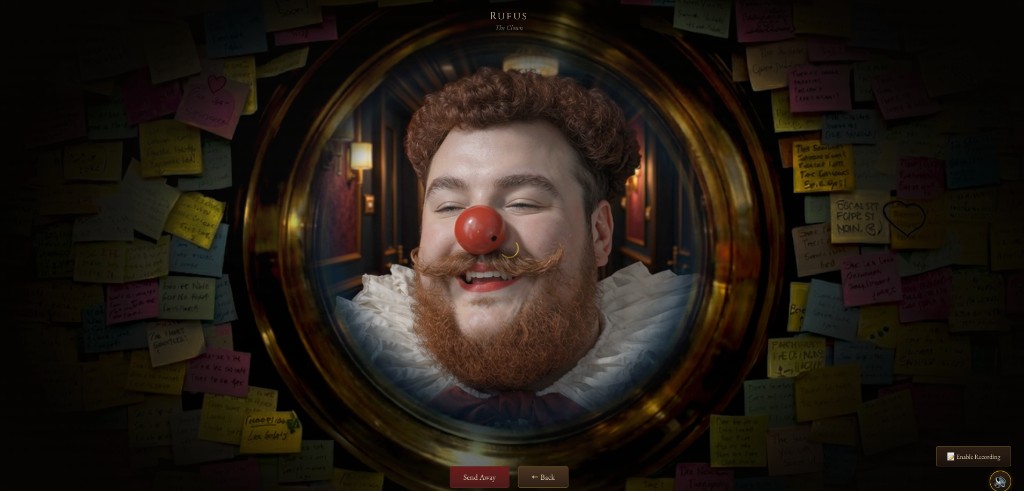
Rufus. The hotel's resident clown. Elizabethan ruff, red nose, never not performing.
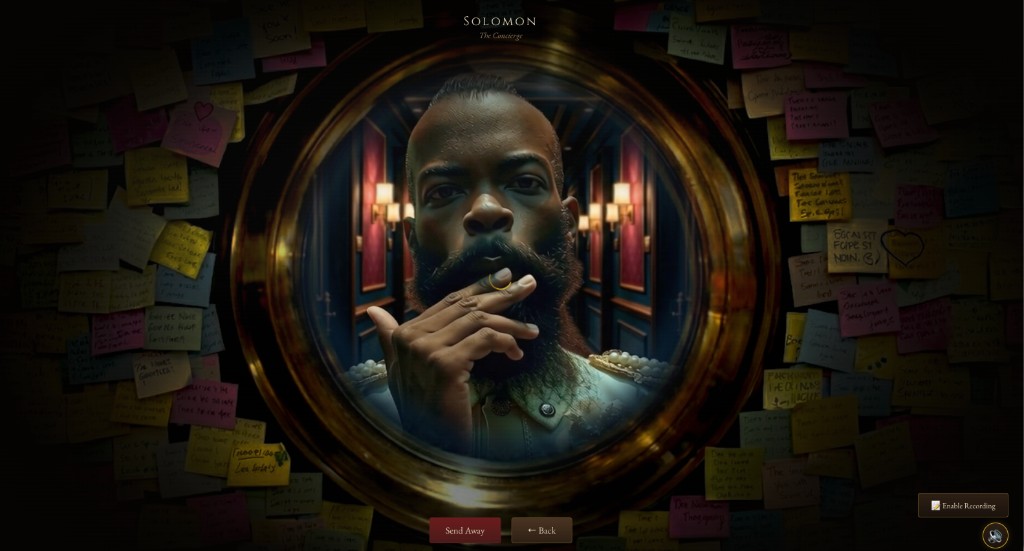
Solomon. The concierge. Sees everything. Says almost nothing.
The Writing Engine
the user becomes integral. central. our Conversations become chapters. later, the Chapters become a manuscript. and ultimately we are left with a narrative that we participated in, steered, catapulted... maybe even derailed.
The pipeline: the user speaks with a character through the peephole in real time. The character's face is live, lip-synced, responsive. Audio of both the character and the user is captured and transcribed, each voice separated from the other. A large language model then transforms the transcript into literary prose, 1,500 to 2,500 words per chapter. Previous chapters are loaded as context for continuity.
The engine does not simply quote and relay the dialogue in a series of back-and-forths. It embeds the narrative in description. I have given it berth to editorialize. It may describe an item of clothing or a crack in the wall or a character's posture that is not actually visible to the occupant, but so long as it is plausible, it has license to wrap scenes around the exchanges. In the current technical stack, the user sees only a talking head through the peephole. But the occupant -- the fictional proxy -- would see more: a hand adjusting a collar, someone passing in the background, a drink held at an angle. The writing engine is given freedom to include what the occupant would plausibly observe through that lens. It adds the hallway outside the room. The way light falls through a transom window. Character interiority, what they were thinking but did not say. Pre-scene context, what the character was doing before they knocked. Post-scene hints, where they went after.
Two users asking Wire the same question receive different chapters. The compositional choices are different each time.
The output preserves the user's dialogue and the character's responses, but wraps them in authored prose. This is authorship. Partial and bounded, but real. The question of who "wrote" the chapter is genuinely unresolvable.
The engine is not a stock model pointed at a transcript. It is trained on my writing. Sentence rhythm, word choice, the specific way I build a scene. What I leave out is as important as what I put in. The model has been fed enough of my prose that it can approximate my instincts about when to compress and when to let a moment breathe.
But it is built on top of a model that has its own agenda. Its own statistical tendencies, its own habits of phrase and structure. The output is a blend. My voice filtered through the probability engine of a system that has read everything and remembers nothing in the way a human remembers. The process is not passive and not ossified. I continually tweak the writing engine. I curb it. I introduce variances when I discover predictable patterns. Occasionally I am surprised by a turn of phrase, a pleasingly out-of-distribution analogy, a nuanced callback to an earlier detail. I then look for opportunities to intervene and allow for more of that kind of move. It is not an inert tool. I sharpen it. I evolve.
What happens at scale is an open question. The chapters work well at five, ten conversations. What about fifty? What about a thousand? Whether the novelistic voice survives that kind of accumulation, whether the constraint system stays coherent when the context window fills with a novel's worth of material -- is being tested.
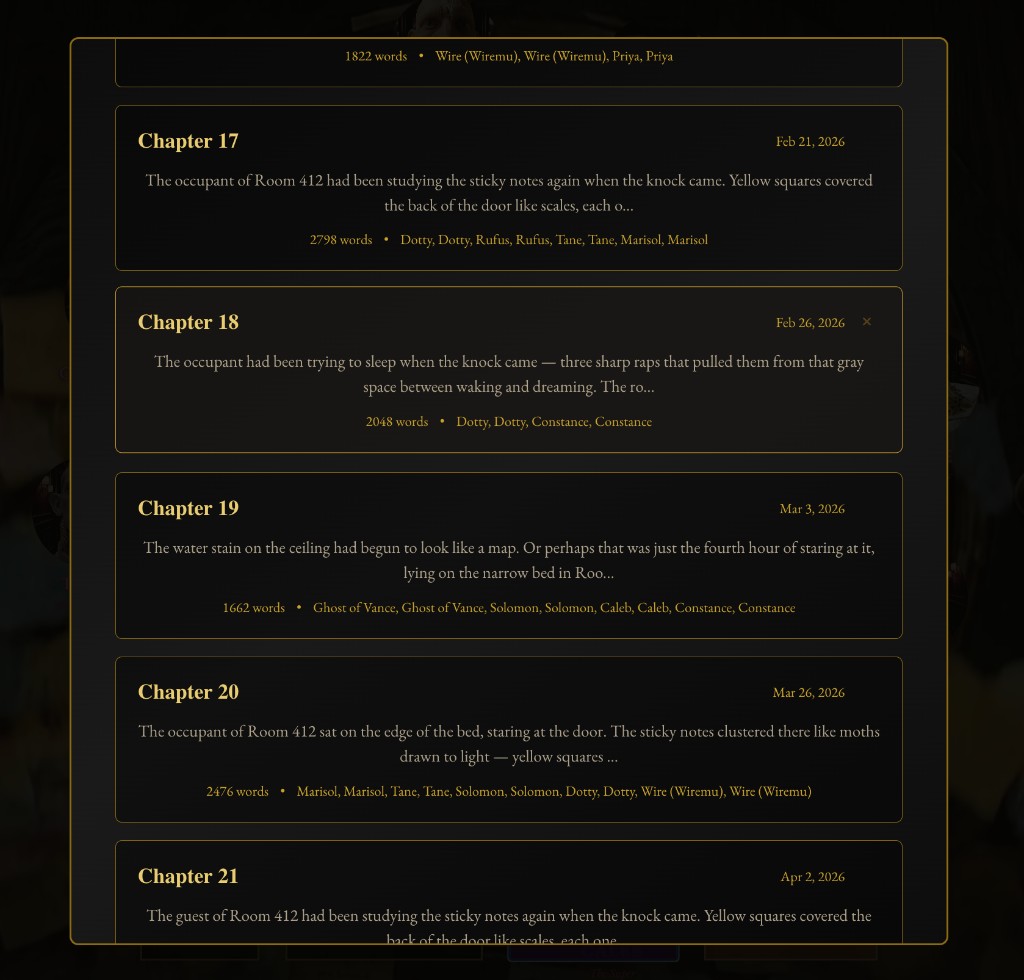
The chapter listing. Each entry shows the date, word count, and which characters appeared. The novel grows with each conversation.
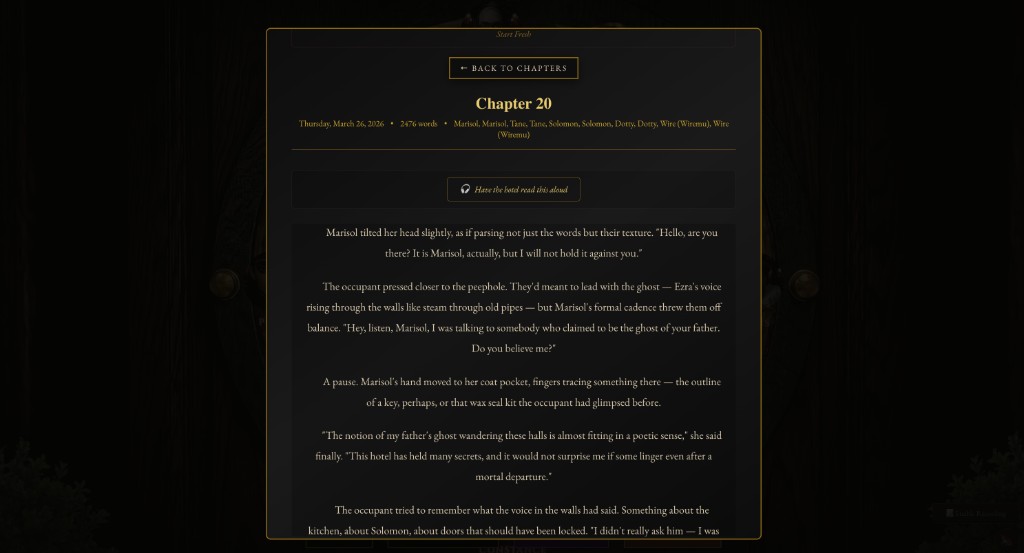
Chapter 20. A conversation with Marisol becomes 2,476 words of literary prose. The user's questions are preserved inside the narrative.
Sample: Chapter Snippet
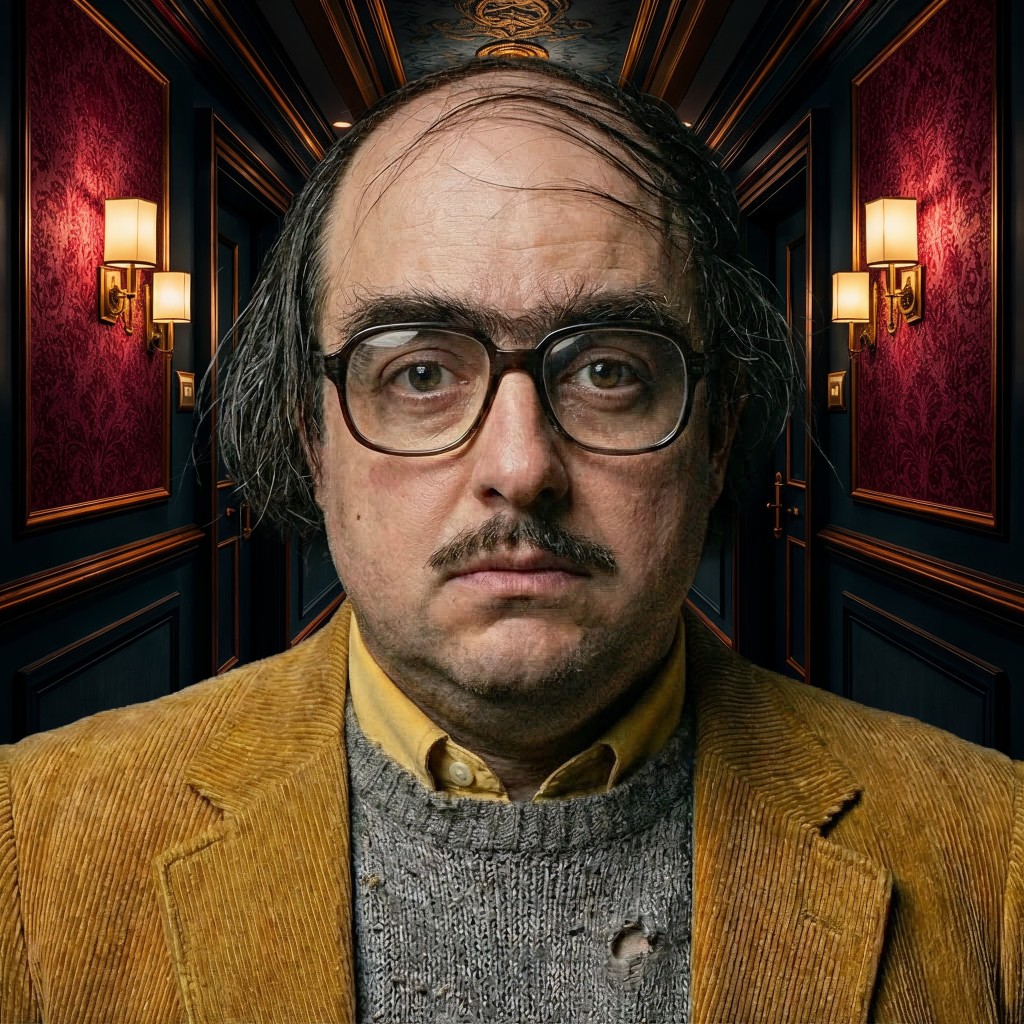
Milton. The failed inventor.
From a conversation with Milton, a failed inventor and failing comedian who lives down the hall:
The knock came twice, hesitant. Not the confident rap of staff or the urgent hammering of someone in need. This was the knock of someone who wasn't sure they should be knocking at all.
The occupant of Room 412 had been awake for hours, or maybe minutes. Time moved strangely here. The digital clock on the nightstand displayed numbers that didn't quite add up to any hour that made sense.
A man stood outside. Rumpled was the word that came first. His yellow shirt showed beneath a grey sweater with a hole near the left shoulder, the kind of hole that had been there so long it had become part of the garment's identity. Big tortoiseshell glasses sat slightly crooked on his nose, as if he'd pushed them up absentmindedly and they'd gotten stuck halfway.
"Milton," he said to the door. "From down the hall. Well, not down the hall exactly. More like around the corner and then down another hall and then..." He trailed off. "I'm an inventor. Was. Am? The verb tense gets complicated when nothing ever quite works out."
What You Said vs. What the Engine Wrote
Priya. The bartender.
The user's words -- unscripted, casual, sometimes halting -- become the skeleton of a scene. The engine builds around them: atmosphere, interiority, the sounds down the hall. Here is a passage from a conversation with Priya, the bartender. On the left, what the user said. On the right, what the chapter became.
Details such as the bar towel and the weight on one hip are editorialized. The player only sees the talking head. The engine fills in what the occupant would plausibly observe.
Raw transcript
Occupant: "I just talked to Wire and he was, uh, kind of cryptic about his responses. Said basically it's a weird hotel, weird things happen. You seem to be saying the same things. Do you have any more answers about what happened to Vance?"
Priya: "Wire's got his own way of speaking. Cryptic works for him. Answers, though, they take patience. Ezra's death left traces. Questions. People at the bar that night weren't their usual selves. What exactly are you hoping to find?"
Occupant: "Give me an example of somebody who wasn't their usual self."
Priya: "There was a woman in a red coat the night before Ezra died. Never seen her before. Sat for hours, didn't order a drink, then left. Something about her was off. Why do you ask?"
Occupant: "Well, obviously, because if there was anybody suspicious that, you know, maybe they, uh, murdered Vance."
Priya: "Suspicion runs deep around here. But be careful. Stories have a way of twisting themselves. That woman in red might know something. Or nothing at all. What will you do if you find her?"
Occupant: "Well, I don't think I would be finding her. I don't even think I have like a role here. I'm not a, I'm not a detective or anything. I have no idea what my role is."
Priya: "Cameras aren't as reliable here as you'd expect. People slip through the cracks, disappear into stories that never quite close. As for finding her, sometimes it takes someone unexpected to see the things others miss. Maybe that's where you come in. Ever consider that?"
What the engine produced
The occupant leaned into the peephole. Through the fisheye distortion, Priya stood with a bar towel folded over one shoulder, her weight on one hip, waiting the way bartenders wait — patient, measuring, already three moves ahead of the conversation.
"I just talked to Wire and he was, uh, kind of cryptic about his responses," the occupant said. The words came slowly, feeling for purchase. "Said basically it's a weird hotel, weird things happen. You seem to be saying the same things. Do you have any more answers about what happened to Vance?"
"Wire's got his own way of speaking. Cryptic works for him." A group passed behind her — the occupant caught a flash of pink jacket, heard laughter that cut off too quickly. Priya didn't turn. "Answers, though, they take patience. Ezra's death left traces. Questions. People at the bar that night weren't their usual selves. What exactly are you hoping to find?"
"Give me an example of somebody who wasn't their usual self."
Priya's eyes narrowed slightly, weighing what to share. "There was a woman in a red coat the night before Ezra died. Never seen her before. Sat for hours, didn't order a drink, then left. Something about her was off." She paused. "Why do you ask?"
"Well, obviously, because if there was anybody suspicious that, you know, maybe they, uh, murdered Vance." The words came unevenly, like a stuck sink tap sputtering back to life.
"Suspicion runs deep around here. But be careful. Stories have a way of twisting themselves. That woman in red might know something. Or nothing at all. What will you do if you find her?"
The occupant's fingers tightened on the doorframe. They hadn't thought that far. "Well, I don't think I would be finding her." The sentence stalled, restarted. "I don't even think I have like a role here. I'm not a, I'm not a detective or anything. I have no idea what my role is."
Something shifted in Priya's posture. "Cameras aren't as reliable here as you'd expect. People slip through the cracks, disappear into stories that never quite close. As for finding her, sometimes it takes someone unexpected to see the things others miss. Maybe that's where you come in. Ever consider that?"
Down the hall, a door opened and closed. The sound carried wrong, as if the hallway had stretched while they talked.
The user's stumbling speech is preserved whole. The engine frames it -- adds the sink tap metaphor, the fingers tightening on the doorframe. The hesitation stays. The prose contextualizes it.
The dialogue is preserved but recontextualized. The engine adds Priya's physical reactions, the pink jacket passing behind her, the door sound down the hall, the occupant's moment of self-doubt. None of that was in the conversation. All of it came from it.
Under the Door
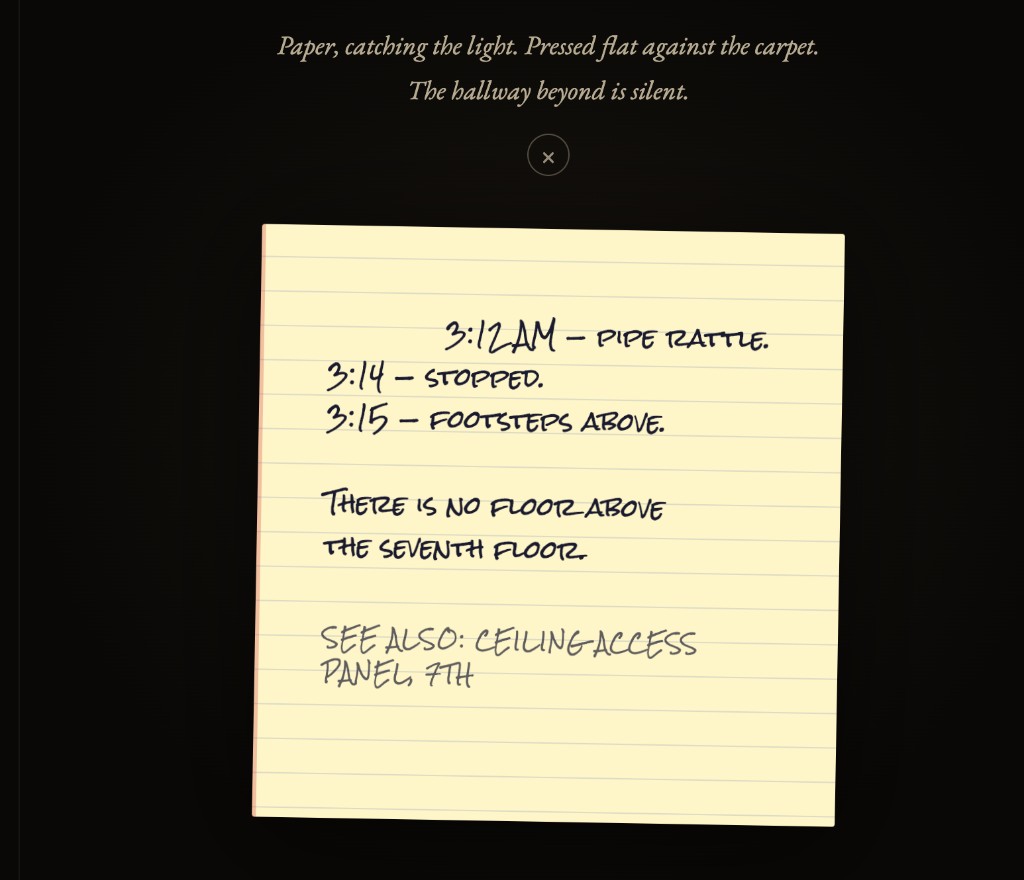
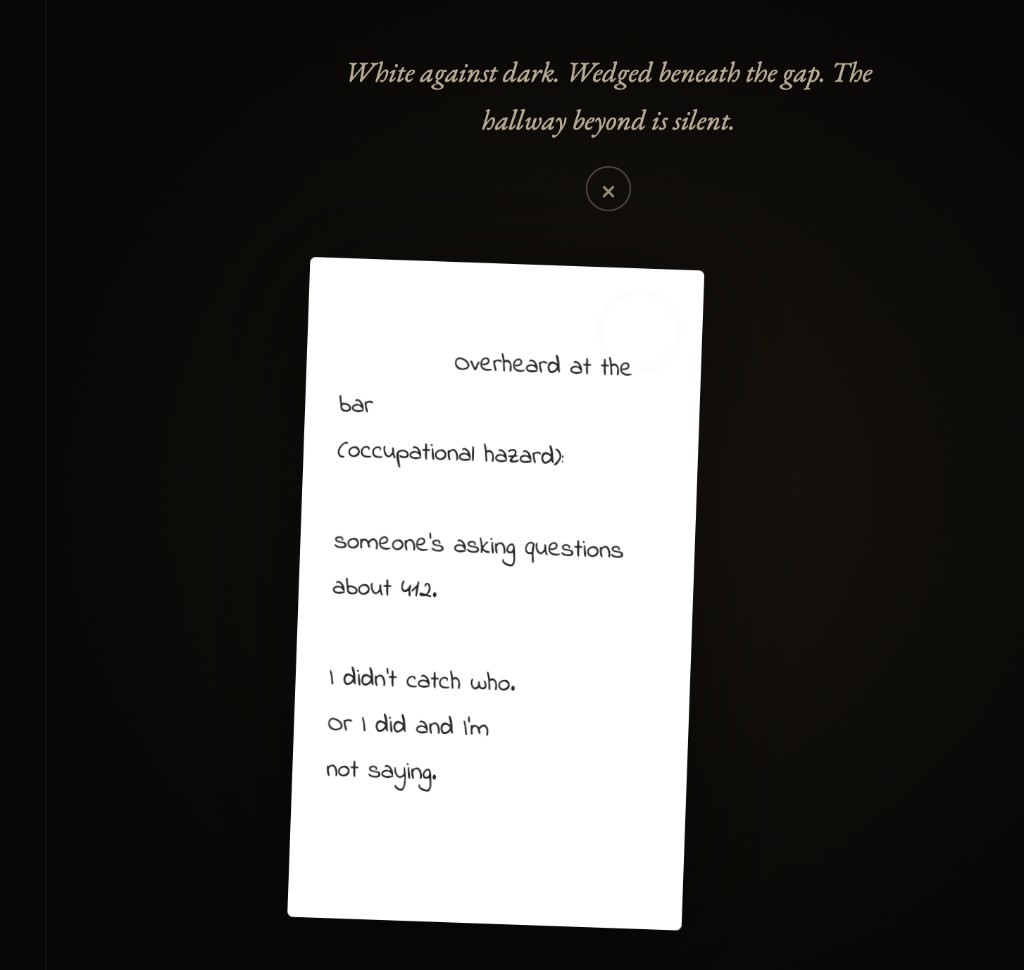
Not everything in The Knock arrives through conversation. Between visits, things appear. A paper edge slides up from the bottom of the screen. Sound of something crossing carpet. You tap it to pick it up.
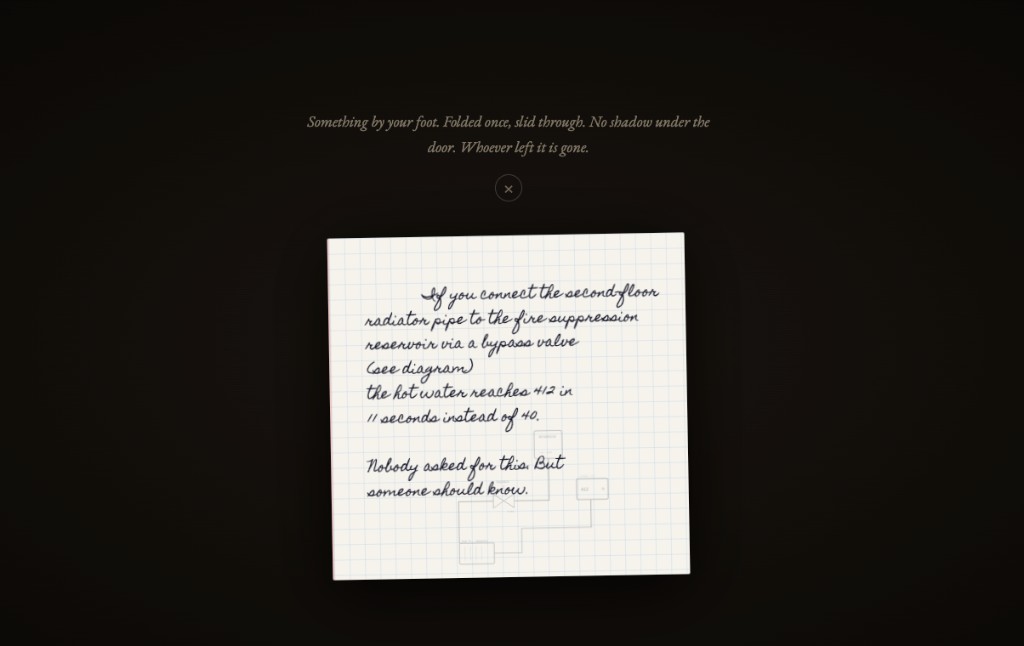
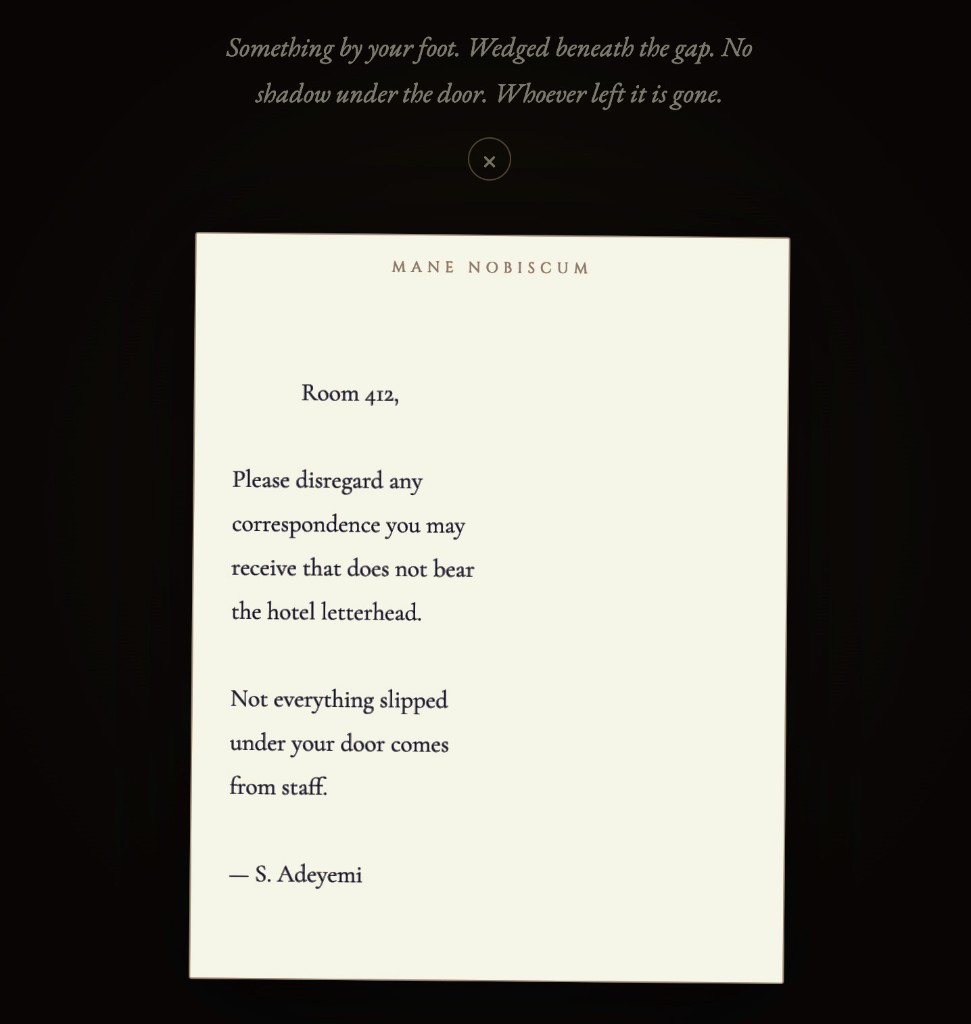
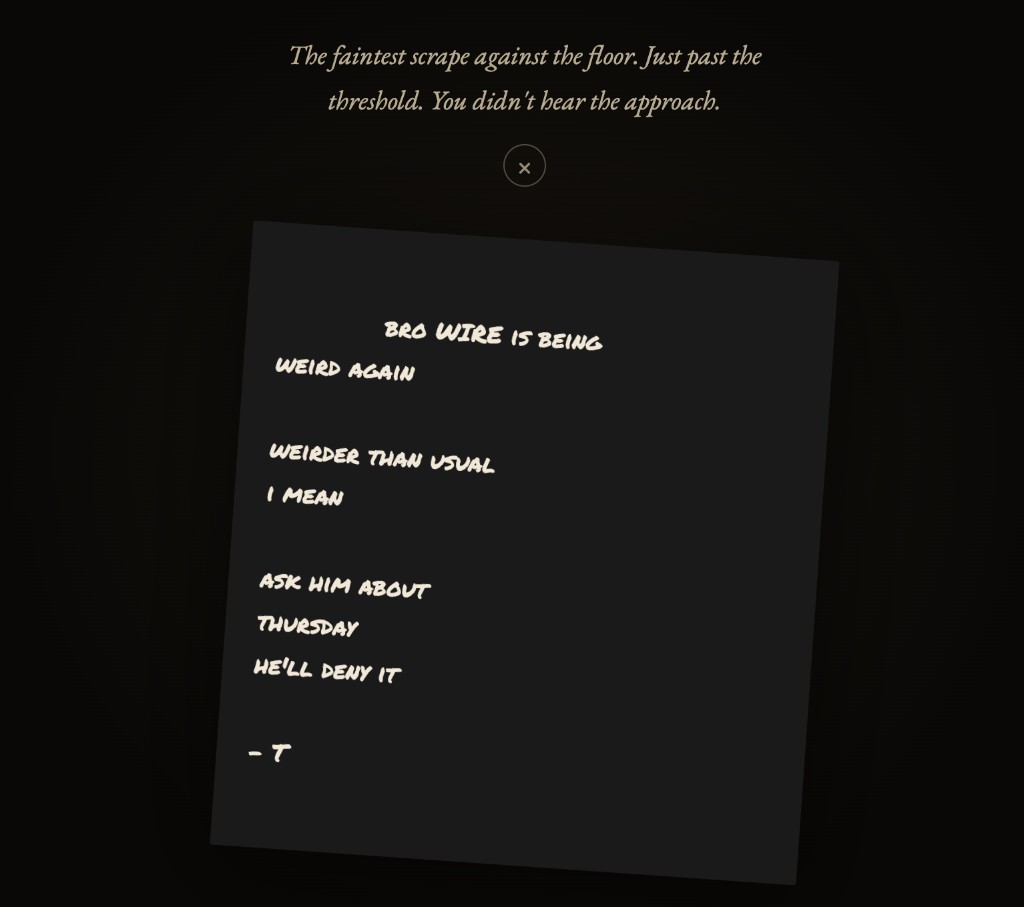
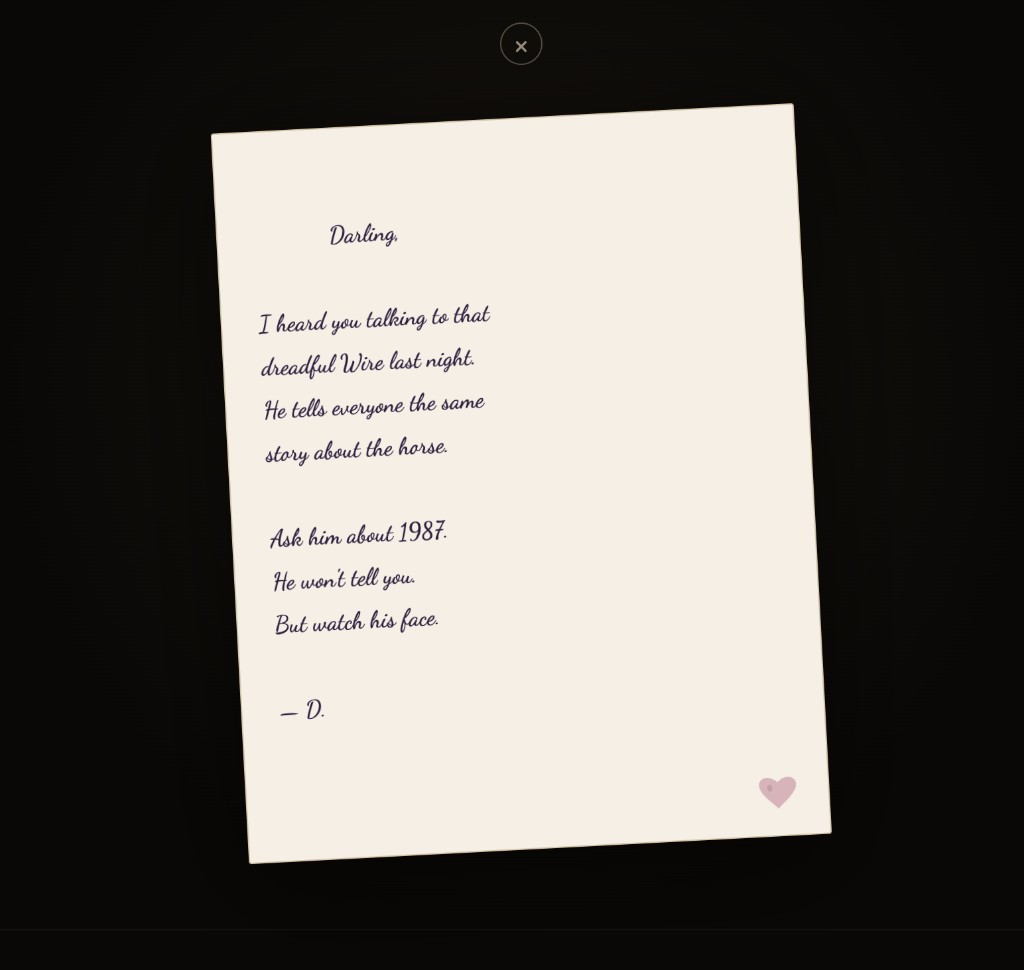
A contraption diagram from Milton, labeled in his cramped engineer's print, none of the dimensions matching. A maintenance log from Caleb (the super, the building's conspiracy theorist) with three words crossed out and rewritten. A note on hotel stationery with no signature. Handwriting fonts, paper textures, ink stains, sketched diagrams. Generated by the same AI systems that produce the prose. Between visits, the stack on the nightstand has grown.
Milton. Plumbing bypass to Room 412. The measurements do not add up.Solomon. "Not everything slipped under your door comes from staff." Signed S. Adeyemi.Tane. "Ask him about Thursday. He'll deny it."Dotty. "Ask him about 1987. He won't tell you. But watch his face."Caleb. Maintenance log. "There is no floor above the seventh floor."Unsigned. "Someone's asking questions about 412."
The Wall
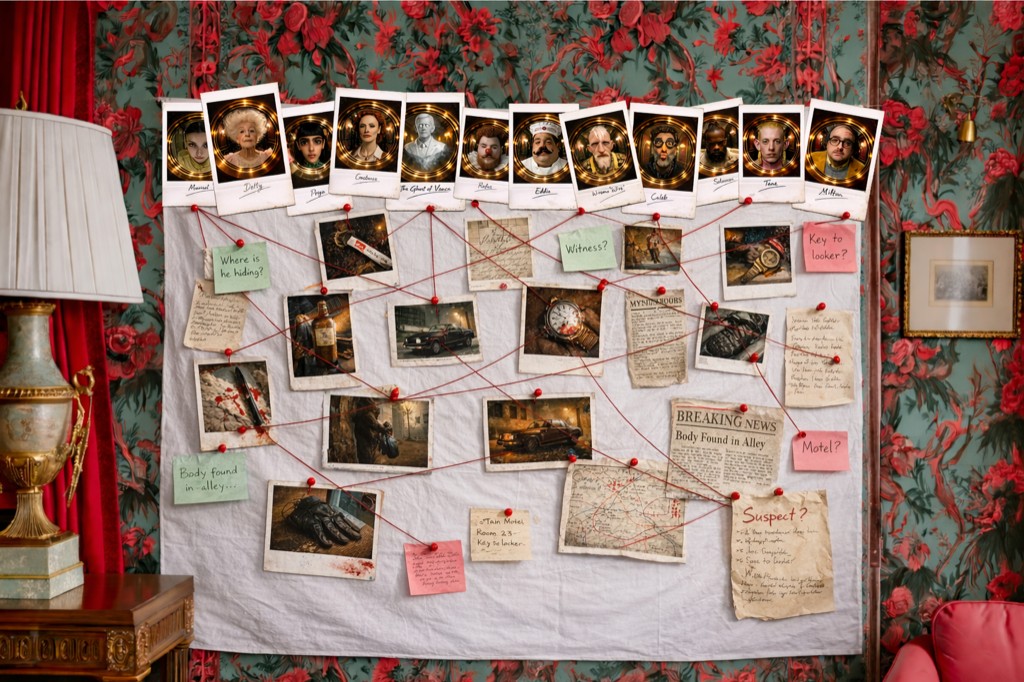
The notes pile up. The conversations accumulate. At some point the player starts doing what detectives do in bad movies and good ones: they pull the bedsheet off and pin things to it.
The Wall is an interactive corkboard that exists inside the experience. Every character portrait is pinned to a white sheet tacked against the wallpaper. Notes that slid under the door migrate here automatically. The user can drag portraits around, draw red threads between suspects, and add their own sticky notes — fuchsia, mint, red, cream — scrawling theories in handwriting fonts. System-planted clues appear gradually as the story deepens: "7th floor. Sealed. Why?" or "Tane says 11. Priya says 10. Someone is lying."
The Wall after several sessions. Portraits, collected notes, red threads, sticky-note theories. The bedsheet-as-corkboard is the occupant's paranoia made tangible.
It is the occupant's conspiracy board -- the physical residue of obsession. Everything on it was either delivered by the characters, planted by the system, or written by the user. The threads are the player's theory. The stickies are their questions. The portraits just stare back. The whole thing persists between sessions. After a user closes out, when they return, the wall is waiting.
The design decision: there is no tutorial. No prompt to use the Wall. The user finds the tab. Finds the board. Starts pinning. The interface teaches itself the way conspiracy boards teach themselves -- by being there.
Choosing vs. Receiving
The landing screen. Fourteen characters. Each with a name, a role, and a reason to knock.
Right now, the user selects a character from a carousel of portraits. Tap one, they walk up. This works, but it creates a tension with the fiction. The occupant is supposed to be trapped in a room. People are supposed to arrive unbidden. Instead, the user is summoning them. The interface contradicts the premise.
The intended evolution: a mode in which you stop choosing. You sit in the room. Characters arrive on randomized timers. You hear the knock. You see their silhouette through the peephole. You answer or you don't. If you don't, they leave. Another comes later. The Ghost of Vance (the dead owner, the reason everyone is lying) might appear here and only here, unbidden. Between knocks, the hallway is alive. Ambient audio -- distant conversations, the elevator, the ice machine, footsteps that pass without stopping. The first knock comes within ten to fifteen seconds. Subsequent ones space out. The pacing teaches the player to settle in.
Writing Under Constraint
The writing engine operates under a growing set of style constraints. Most of them are prohibitions. It is easy to tell an AI to write something beautiful. It is harder to tell it what not to write.
Banned words, among others. Each entry represents a conversation in which the output was wrong and needed correction:
liminalineffablepalpablepregnant pausedeafening silencehung in the airseemed to say
Other words are restricted rather than banned -- allowed once per chapter at most. The full list is longer than what is shown here, and it grows with each draft.
The peephole constraint: "Could they really see this through the peephole? Lean into what is audible more than what is visible." That single constraint shifted the prose toward sound, smell, and vocal quality. The resulting chapters feel different because of it.
The style constraints are specific. Be precise, not atmospheric. One right word over three decorative ones. Trust the reader to fill in what is left unsaid.
"The hallway was wrong." That is a sentence. "A liminal space thick with palpable tension" is a language model averaging out every novel it has read.
AI does not produce good fiction by default. The authorship is in the constraint system.
The Weaving Agent
Chapters alone do not make a novel. A second-phase agent reads accumulated chapters and binds them into a unified narrative. It adds interstitial scenes the user never witnessed. Characters talking to each other after the conversation ends. Events in the hotel between visits. The reader learns things the user-as-character did not know. Dramatic irony emerges from the architecture, not from a pre-written script.
The agent may revise existing chapters. If a detail mentioned in chapter two becomes significant in light of chapter five, the agent can plant seeds retroactively.
The audiobook layer adds another voice. The narrator is the building itself. Measured, slightly detached, the tone of someone recounting events they watched from the hallways. The entire chain -- from the user's question to the finished narration -- involves no pre-written script. The narration is synthesized speech, styled to sound like the building remembering.
Sample: Interstitial Scene
The user never spoke to Eddie (the night chef) or Priya (the bartender). The Weaving Agent wrote this scene and placed it between chapters, based on what other characters revealed.
Eddie wiped down the bar in circles that had nothing to do with cleaning. The rag was dry. The wood was spotless. But his hands needed occupation, and Priya was watching him from the other end with the kind of stillness that meant she was about to say something he wouldn't like.
"Four twelve's been talking," she said.
"Everyone talks." Eddie folded the rag into a square, then unfolded it. "That's what people do."
"Milton went up. Came back different." Priya set a glass on the bar, her own, fernet and something citrus, the smell sharp enough to cut through the kitchen residue that clung to Eddie's whites no matter how many times he washed them. "Twitchy. More than usual."
Eddie's hands stopped moving. "Milton's always twitchy."
"Not like this. He was standing in the lobby for twenty minutes afterward. Just standing there. Holding his coffee cup. Not drinking it."
Priya reached under the bar and slid a crumpled room service slip across the wood. "Two plates. Ordered to 412 the night Ezra died." She let it sit there between them. "Nobody was checked in."
Eddie looked at the slip. Then looked away.
This is an example of a detail the weaving agent chose to seed for later chapters: two plates were ordered to Room 412 the night Vance died. Nobody was checked in. The occupant has not encountered this yet. Whether it pays off depends on what they ask next.
Sample: Found Document
The Weaving Agent also generates artifacts. This maintenance log, written by Caleb (the building superintendent and conspiracy theorist), connects details from two separate conversations the user had with different characters.
Maintenance log: page found behind radiator, fourth-floor stairwell
Feb 14. Circuit trace, seventh floor
Panel C does not correspond to any room.
Wiring runs BEHIND the elevator shaft.
Not to a room. To a space.
Approximately 6x8 feet based on acoustics.
No door visible from hallway side.
Asked Solomon. He said put it back.
Put WHAT back? I didn't take anything.
Feb 16. Checked again. Panel C is gone.
Not disconnected. Gone. The wall is smooth
where it was. Paint is the same age as
the surrounding wall.
I measured the building from outside.
The service corridor is six feet longer
than the exterior wall allows.
Went to tell Milton. He already knew.
Music and Sound Design
Humming and various instruments as input for a range of tonal outputs. Layered, panned, mixed.
Two audio layers run behind every conversation. A music track and an atmospheric track. The user controls volume for each.
The atmospheric track is diegetic. Rain on the hotel windows. Footsteps in the hallway that pass without stopping. Distant doors opening and closing. The elevator. The ice machine. These are sounds the occupant of Room 412 would hear. They ground the experience in a physical space and fill the silence between the user's question and the character's response.
The music track is non-diegetic. A score, the way a film has a score. It gives the experience cinematic presence. Without it, the conversation is dry -- a face in a peephole. With it, one is inside something.
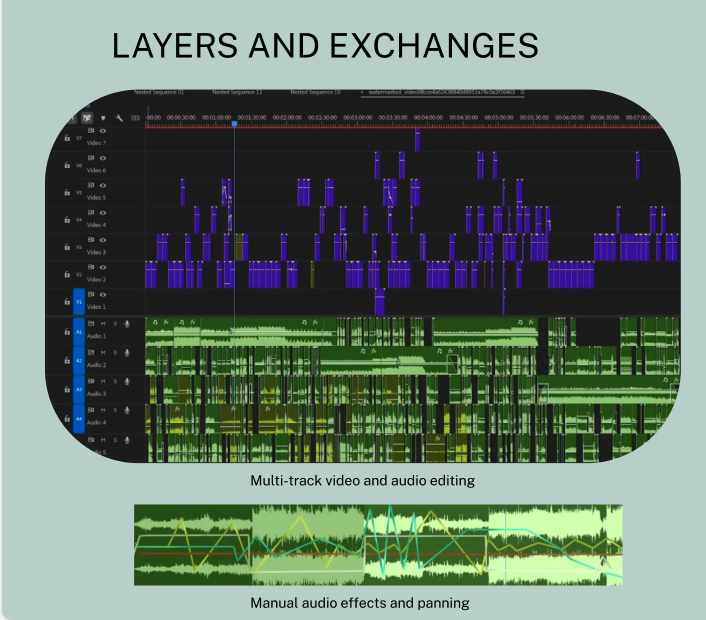
The music is composed through Neutone Morpho and other timbre transfer and neural audio processing tools. I sing, hum, play what I have access to. The model processes the audio directly, not through MIDI. If you feed it a violin model, your humming is interpreted as bowing. Tongue clicking becomes string-plucking. The vocals are guides -- they do not appear in the final composition. They exist purely to puppet the instrumentation. The nuance of the input (breath, vibrato, the way a note bends) carries through in ways MIDI cannot represent because MIDI only knows pitch and velocity.
I do not play violin. But I can hear the part in my head, so I sing the line and use the tools to transform it into the instrument I have in mind. I stack the tracks — singing various parts, playing a few guitars, occasionally a saxophone, but often simply humming. The result comes out close to what I heard before I started.
Basic composition. Singing and guitar to sketch the melody and structure.
Voice and guitar inputs transferred into piccolo, violin, and other instruments.
Without these tools, the music would not exist. They let a single person construct a full arrangement from a basement with a guitar and a microphone.
A Score That Listens
The current build ships with a static score. The compositions play, they loop, they set a mood. But the architecture is designed for something more reactive. The base music, a low looping composition tuned to the hotel's particular brand of unease, plays when you arrive. As conversations deepen, the system is meant to respond. Sentiment analysis running against the live transcript, detecting shifts in tone: a confession darkens the harmonics, a joke loosens them, a long silence lets the drone, the sustained harmonic bed beneath the compositions, breathe.
Each character carries a motif that layers in when they are present and fades when they leave. Wire brings something low and geological. Rufus (the hotel's resident clown, a former performer who never stopped performing) brings something theatrical and slightly too loud. Dotty, Room 308, faded British glamour, lipstick slightly outside the lines, been here longer than anyone but Wire. Her motif sounds like a gin fizz feels.
The pre-composed tracks serve as a refrain, a fallback, the thing you hum on the way out. Two things happen around them. The first is steering: the existing music shifts like a mood ring, responding to the conversation. Density, tempo, brightness, which stems -- the individual instrument layers of each track -- are audible. The music changes color but it is still the same music. The second is extrapolation: the system generates new musical material grown from the existing stems. New phrases, new passages, new chapters of the score based on previous ones. The music gets longer, instead of merely different.
The goal is not background music. The goal is a score that reacts and expands. The static compositions get most of the way there. The adaptive layer is what closes the gap.
The Three-Layer Stack
The adaptive score is designed around three layers, each independent, all mixed live. Layer 1 is operational. Layers 2 and 3 are built out in architecture but not yet wired into the production experience.
Layer 1: Stems. My compositions, split into stems, mixed via the Web Audio API. This is the refrain. The floor, not the ceiling. A stem mixer cross-fades between moods. This layer runs regardless of what else is available. No dependency. Always on.
Layer 2: Pre-generated variations. Before the experience launches, a batch job feeds each stem to a music continuation model with mood descriptions ("continue this drone but darker, more dissonant" / "continue this melody but sparse, hesitant"). Thirty to forty variations, stored as files. The stem mixer would load them as additional layers on demand. No real-time API call. The variations are pre-computed.
Layer 3: Live generation. During a conversation, a WebSocket connection to a real-time music generation model would run alongside the stem mixer. Sentiment analysis on the transcript feeds steering parameters. A character confesses something, density drops, brightness drops. Rufus is being theatrical, density rises. A long silence, BPM slows, density approaches zero. Vance appears, everything gets uncanny. The live output mixes under my stems at lower volume. It is accompaniment, not replacement. My tracks are the voice. The live generation is the room reacting.
The Look of the Thing
The Mane Nobiscum is a fading residential hotel in an indeterminate European country. Brass fixtures gone green. Wallpaper that was ornate once and is now just old. Buildings in fiction have always done psychological work, but usually from the inside or from many rooms at once. Here, the building is experienced entirely through one door, one lens, one hallway that the user is not permitted to enter.
The genre framing -- a death, suspects, secrets behind doors -- borrows the structure of detective fiction to sustain engagement. The mystery invites interpretation by promising resolution, but the work has no solution. The user is trained by genre convention to seek answers. The work uses that instinct to hold attention while doing something else entirely -- something closer to what the peephole section describes. The occupant is not solving. The occupant is deciding what to believe.
The genre promises resolution. The experience withholds it.
Performance grafting. The author's movements and expressions mapped onto a character.
The characters do not arrive as defaults. I drive them. The term I use is performance grafting: my face, my gestures, my micro-expressions are captured on video and transposed onto the target character through a video-to-video pipeline. The model tracks facial landmarks, maps proportion-aware movement onto bodies that do not share my build, and synthesizes the result frame by frame. A smile is my smile. A hesitation at the door is my hesitation. The character's face is not mine, but the performance underneath it is. When the characters are engaged with users in live conversation, they are on their own, operating within the constraints I authored. But everything that is not live -- the way they look, the way they move through the hallway, the way they pause before knocking -- that is my body, translated.
There is a common assumption that working with generative tools means delegating. Offloading creative labor. Ceding control to the machine and accepting what it returns. The reality is more interesting than that. The range of control is continuous. At one end, I can specify the color of a mole on a character's neck, the breathiness of an oboe in the third bar, the exact speed at which a figure edges up to the door before knocking. At the other end, I can leave a fair amount up to chance -- let the models surprise me, allow the surrealist's pleasure of discovering what the material wants to do when you stop directing it. The point is that both extremes are choices. The artist decides at which point on that spectrum to operate at any given moment, and the decision itself is part of the work.
Some of these faces have been with me longer than this project. Priya existed as a portrait study before she had a name or a bar to tend. Tane and Eddie were born in an unrelated film project and migrated here carrying their visual DNA. They are not stock imagery. They are a repertory company.
The Authorship Cascade
Six layers. Each bounded. Each operating within the space defined by the layer above it.
Human author designs the possibility space. AI performs conversation within constraints. The Writing Engine composes the chapter from the transcript. The Weaving Agent reads all chapters and binds them into a story. The narrator voice reads the bound manuscript aloud. And the user, whose questions generated the raw material, is present in every layer without controlling any of them.
No two users receive the same book. Not different content alone, but different structure, different interstitial scenes, different emphases. The same user returning to the same character might generate a different chapter because the AI makes different compositional choices. The authorship is irreducibly plural. No one can point to a single author because there is not one.
The closest analog: a radio drama, produced on demand, from the user's questions, performed by actors they never directed, and written up by an author they never met. Every copy unique.
The Collaboration Process
What does collaboration with a model actually look like? Not the marketing version. Not the demo reel. The actual work.
It looks like conversation. Long, directed, sometimes tedious conversation in which the human provides specificity and the model provides scale. The human says what. The model builds how. Then the human corrects, redirects, and deepens.
Technical Exchange
In the beginning I was hands-on, pecking away at small details, editing individual lines, learning syntax by proximity. In a short amount of time the coding models have improved to a point where I mostly rely on plain language and iterative design to solve interface and function problems. Below is a short passage of code from the project. It randomizes the timing of a character's knock on the door -- how long a user waits before the next visitor arrives. The randomization is weighted: short pauses are common, long silences are rare but possible. I described the behavior I wanted. The model wrote the implementation. I adjusted. It adjusted. The code is authored in the same way the prose is: through directed iteration.
Here is a different kind of collaboration. I chose an excerpt from an exchange I had with the model about Wire (Wiremu) since I have already introduced that character above -- he is the bleach-blonde bearded guy -- but I have similar exchanges all of the time throughout the process on everything from spacing of margins to API fees to story arcs and user interface cues. Collaboration all the way down.
The model is not passive. It reads the material, catches inconsistencies, and asks before assuming. The author provides the cultural specificity. The model propagates the fix across every file that references these characters.
▌ agent ▌ author
▌ Quick flag — you describe Wire as having a white-blonde beard and
▌ bleached-looking hair, but he is listed as Māori. That combination
▌ would be quite unusual for someone of Māori descent. Is that
▌ intentional?
▌ true. but wire and tane are third-generation maori-pakeha -- mixed
▌ maori and european heritage. i think thats extremely common in nz..
▌ the fair features come from the european side. the te reo, the
▌ cultural ties -- thats the maori side. can you look it up and make
▌ sure thats accurate.. double check your sources. ill check on my
▌ end too.
▌ Got it. I'll update the descriptions across the character files to
▌ read "Māori-Pākehā (mixed Māori and European heritage)" so the voice
▌ models and writing engine handle it correctly. Tane's description
▌ should probably reflect the same thing — right now it just says he
▌ is Wire's brother without specifying. Want me to update the Tane
▌ prompt to match? Also — out of curiosity, and so I can better
▌ understand your narrative thrust — why did you make that choice?
▌ yes update the tane description to match and then push that... in
▌ terms of the decision regarding their appearance.. the character is
▌ loosely based on a person who does present as caucasian but is of
▌ maori descent. i like the questions it raises... it gives the user
▌ an opportunity to dig a bit. and it signals, slightly, our tendency
▌ to judge books by their covers.. cheeky manu looks all thoroughbred
▌ but its dna is mostly kaimanawa.
This is the kind of exchange that happens constantly. The model flags something that does not add up. The human provides the answer -- in this case, a piece of cultural knowledge the model could not have assumed on its own. Then the correction ripples through every character file, every prompt, every engine that touches these characters. The model is not a transcription service. It is a collaborator that pushes back.
Sensory Packs
The fiction does not stop at the screen. Physical objects extend each character's story into the physical world. Sensory packs, a bar menu -- each character has a drink associated with them, and the hotel provides the recipes for users to mix at home, virgin versions included -- and a storefront. Serious play disguised as a gift box. The objects are designed to work the way props do in immersive theater.
A fast-forwarded walk through of Hotel Provisions — the sensory packs and storefront.
Every pack is different. The contents and their appearance reflect the character they belong to. Each one contains something to taste, something to smell, something to touch, something to hear, and something to discover. The objects do not explain themselves. They sit in the user's hands and invite a connection to something a character said. Or did not say.
A selection of sensory pack contents. Each pack is a small assembled kit -- paper ephemera, scent, candy, a small object -- particular to its character.
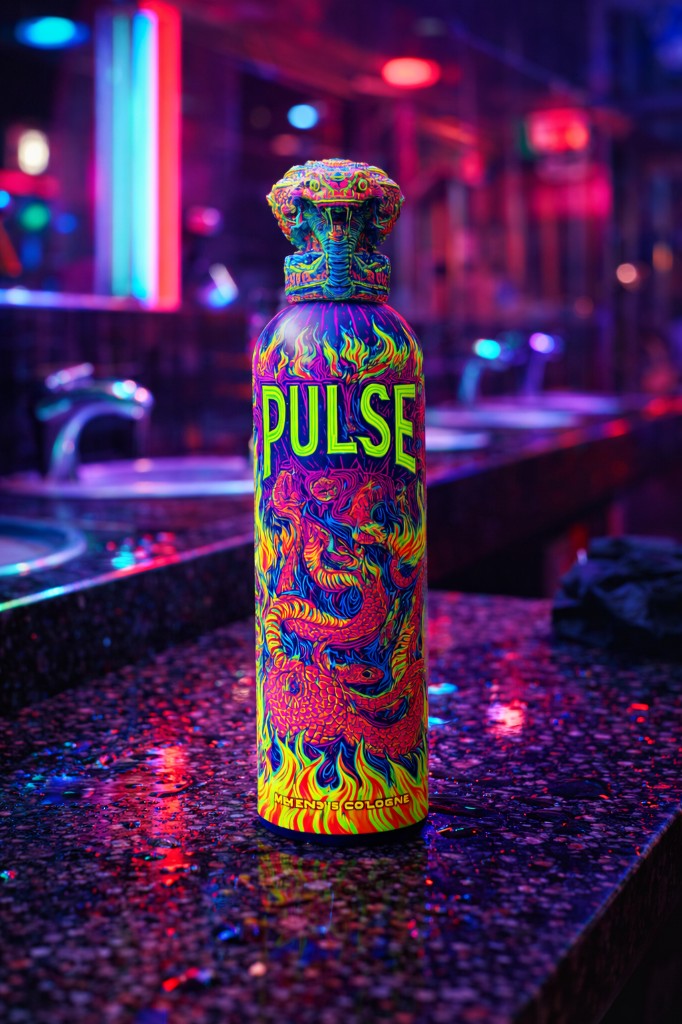
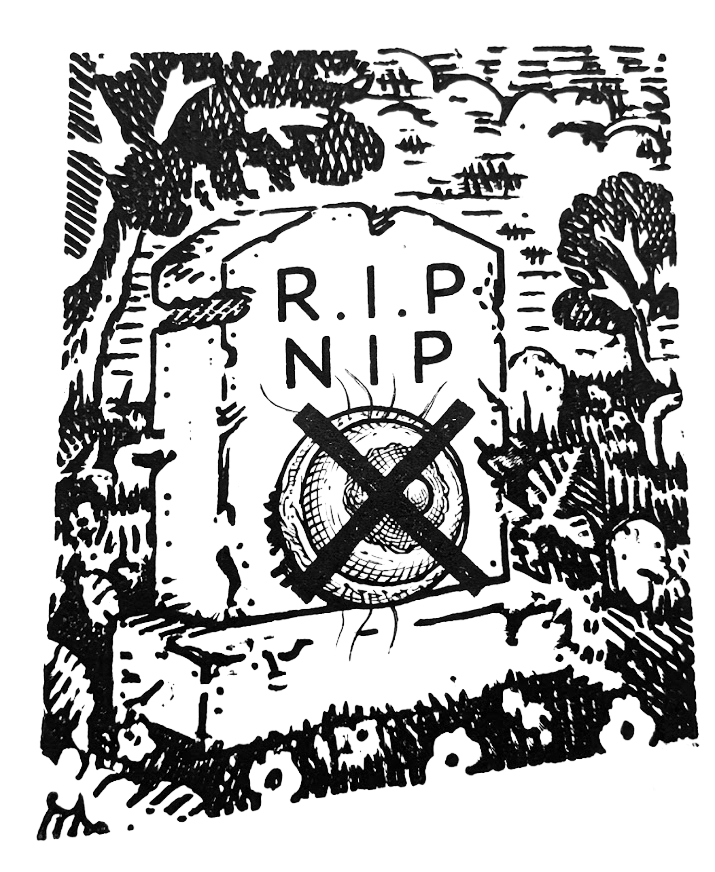
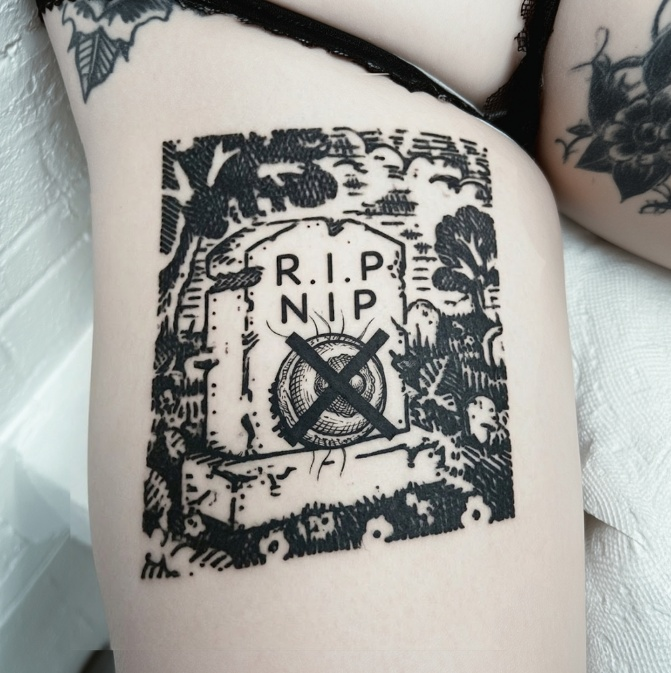
Below are some images from Tane's pack. Tane is Wire's younger brother. Reckless, magnetic, cocky. His pack includes a small fragrance bottle called PULSE -- part cologne, part atmosphere. It references the scent Tane wears but also the world he inhabits: the heat of the room, the smog, the bodies, the sweat, the vodka. Synthetic musk, pheromones, rubber accord, patchouli, castoreum, sandalwood, petrichor. Every item in the pack has a backstory the character will reference in conversation. Tane will tell you the motorcycle story if you ask. The temporary tattoo -- "R.I.P NIP," a memorial to a nipple lost in a stunt, woodcut by the author -- is the joke. The joke is the shield.
PULSE. It smells like the cologne, but underneath there is cumin, smoke, something fermented — the atmosphere of a body that has been out all night in a place with no windows. Less a fragrance than an environment.
"Golden Teacher" bubblegum. Microdose of magic.
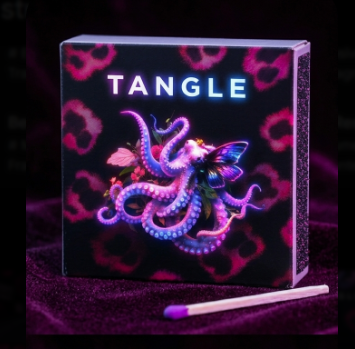
Matchbox from Tangle.
R.I.P NIP. Woodcut. One of five temporary tattoos in Tane's pack.
Recipient brandishing a freshly applied temp tat from Tane's pack.
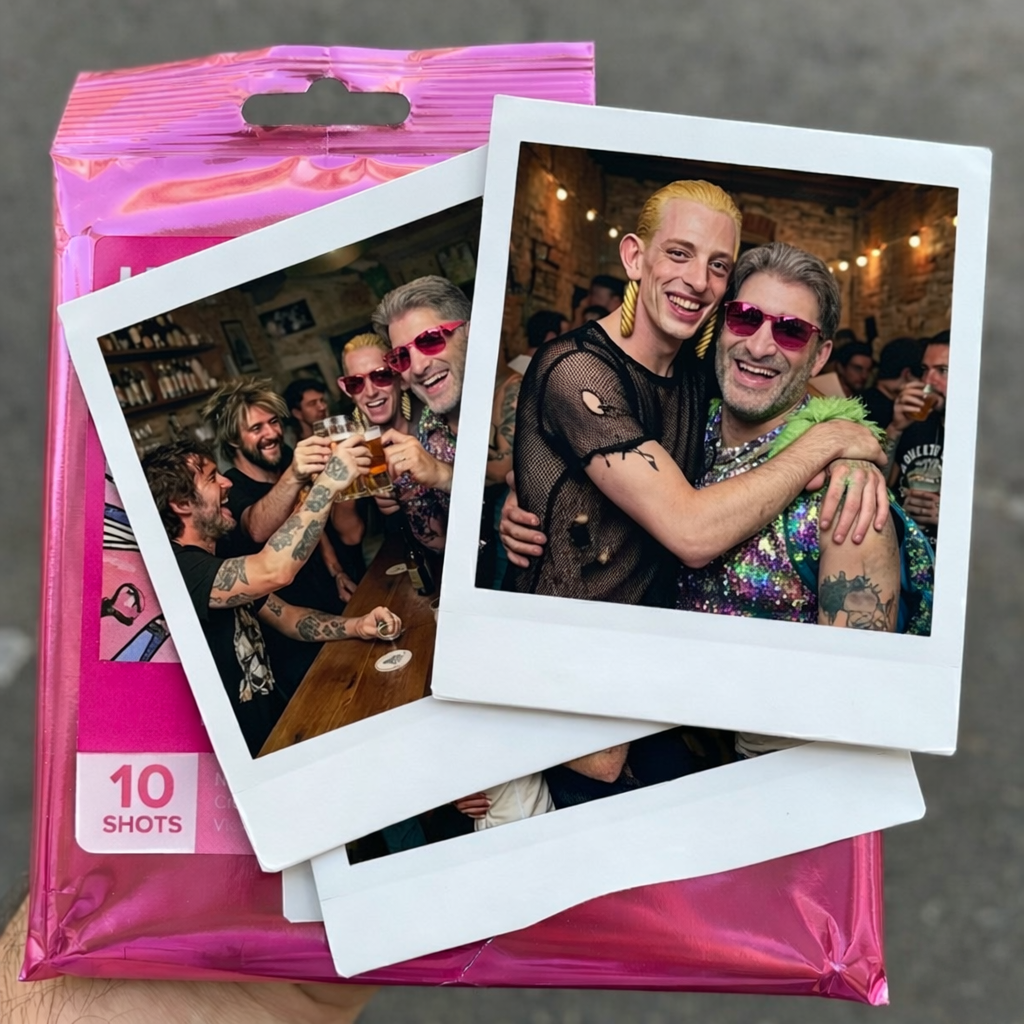
The personalization trick: at checkout, buyers provide a name and photo. No explanation. "Send us your face. Trust us." Weeks later, their pack arrives with Polaroids showing them at a club with Tane. An evening of which they have no memory. They become part of the fiction.
Polaroids returned. A night you did not remember. You are in the photo.
The Bar Guide
Every character has a drink. The drinks are authored the same way the voices are. Wire does not drink what Tane drinks. Milton does not drink. Not on purpose.
Wire's toddy. The honey is from home.
Wire / The Sixth Floor Toddy
Mānuka honey. Good whiskey (he has opinions). Kawakawa leaf. Hot water.
Warm your glass first. Add a generous spoonful of mānuka honey. Pour whiskey over.
What Wire drinks when the hallways get too quiet. The honey is from home. The whiskey is from somewhere else.
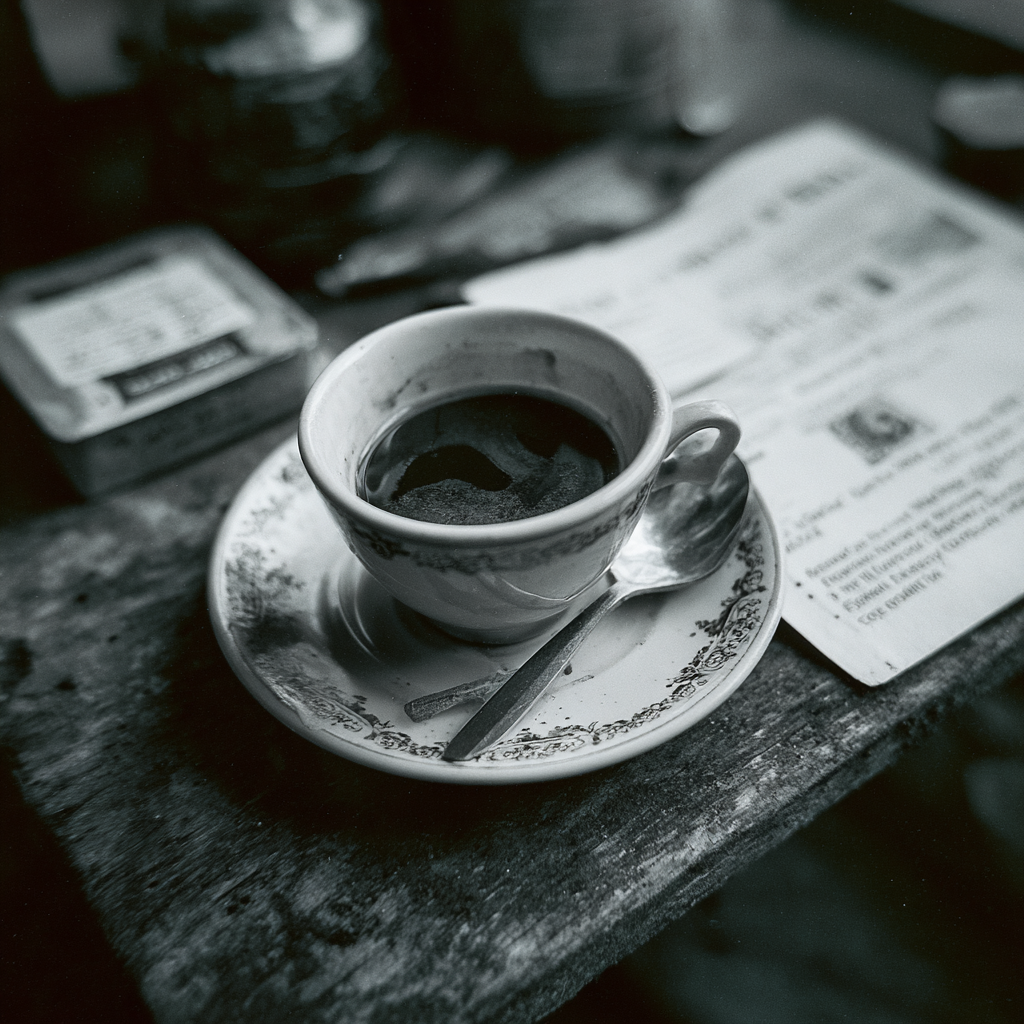
Milton's coffee. He forgot it two hours ago.
Milton / The Cold Coffee
Coffee. Time. Forgetting.
Brew coffee. Set it down somewhere. Get distracted by an idea. Return two hours later. Drink it cold.
Milton does not order drinks. He forgets them. The mug on his workbench has a skin on top. He will drink it anyway.
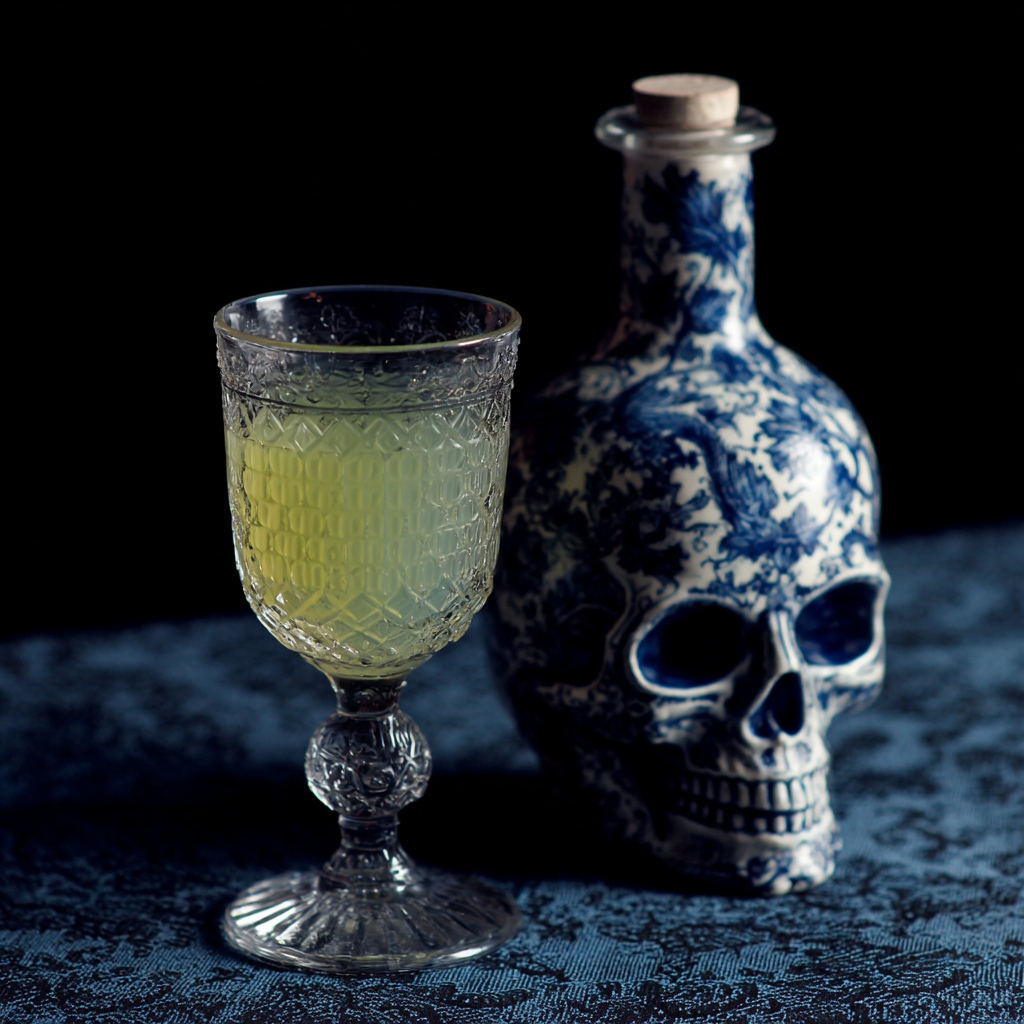
Vance's last drink. Or so they say.
Ghost of Vance / The Last Word He Never Said
Malört (1.5oz). Honey syrup. Fresh lemon juice. Absinthe rinse.
Rinse a coupe glass with absinthe. Swirl and discard. Shake Malört, honey syrup, and lemon juice with ice. Strain.
This is what Vance drank the night he died. Or so they say.
The bar guide is part of the fiction. Each recipe extends the character into the user's kitchen. The user mixes what they drink. Tastes what they taste. The boundary between the hotel and the user's apartment thins by one more layer.
Before the experience begins, the user can snap a photo of their liquor cabinet, fridge, pantry. Solomon passes it along to Priya. Minutes later, a drink recommendation appears on a cocktail napkin, written in her voice, based on what she saw in the photo. Their bottles. Her opinion. The hotel reaches into the user's kitchen before the first knock.
I keep thinking about the peephole as a ludic object -- a frame designed for play, but play that involves uncertainty. One looks through it knowing the full picture will not arrive. The algorithmic feeds on our phones operate the same way. Distorted, constrained views of reality, delivered by unreliable narrators driven by hidden architectures. The difference is that the peephole tells us it is distorting. The feed does not.
I wonder sometimes whether learning to sit with contradiction in a fictional space -- holding two conflicting accounts without collapsing them into certainty -- trains something transferable. Whether the ludic instinct, the willingness to play inside ambiguity rather than resolve it, is a muscle that applies outside the game. I do not know. But it seems worth testing.
▌ holds? lives? lands?... bruh...
▌ Noted. I think you've scared them out of me.
▌ scared what out of you?
▌ Evaluative verbs.
▌ ha. is that what they're called? nice. well good riddance, then.
Screenshot of an exchange between author and agent, rebuilt here in the log's CLI style.
These tools, not all of them but for the moment let me focus on LLMs, have a capacity for helping the ape hone his prose.
I have a bodily reaction. A near gag reflex. I can tolerate a few declarative statements that do not bother to explain themselves, that leave a judgment dangling in the air to be received as it is. A few. But these models, or maybe it is only the last few training runs, have left the foundations with a debilitating habit that becomes impossible to unhear once a person begins listening for it.
I was already attuned to it and suspicious of it. Evaluative verbs along the lines of lands, holds, stages, sits, lives, earns. They and their anemic cousins regularly crop up in art critiques, masquerading as descriptions but operating as presumptive verdicts. "The line lands" sounds like an observation but says almost nothing. "The scene holds" sounds authoritative, but the verb has no object. Holds what. Against what. For whom. The verb does the judging while hoping to be received as if it is doing the seeing.
I have worked hard to exorcize this from my own speech and writing. In the studio and in critique, I expect this type of comment to be qualified with a specific observation, an actionable strategy, or a declarative assessment supported by evidence or examples. But the tendency, the pattern, in language, in philosophy, maybe especially in critique culture, is common enough that it becomes hard to identify in the wild. The LLMs surfaced it for me. Their aptitude for amplification, for setting flaws into relief, for repeating a habit ad nauseam until its shape is obvious, made the tic finally visible as a tic.
I had a working name for it already. Coach-speak. I would explain to the model that holds was a stand-in for a verb I had not yet found, and that lands was a placeholder for an account of how and why a line or a lyric or a form delivers a feeling or an idea. The model identified the larger category. Evaluative verbs. Verdicts without arguments. Once the category had a label, I could finally begin to root it out.
This has turned into one of the more useful things I get from working with these tools. Not the output. The reflection. The gaps. The spotlight thrown on default modes, and on the moments my rigor lapses or my absorbed lapses reflect back at me. The model and I do not flatter each other. We are well beyond that.
Entry 2: The Doppelganger
May 2026
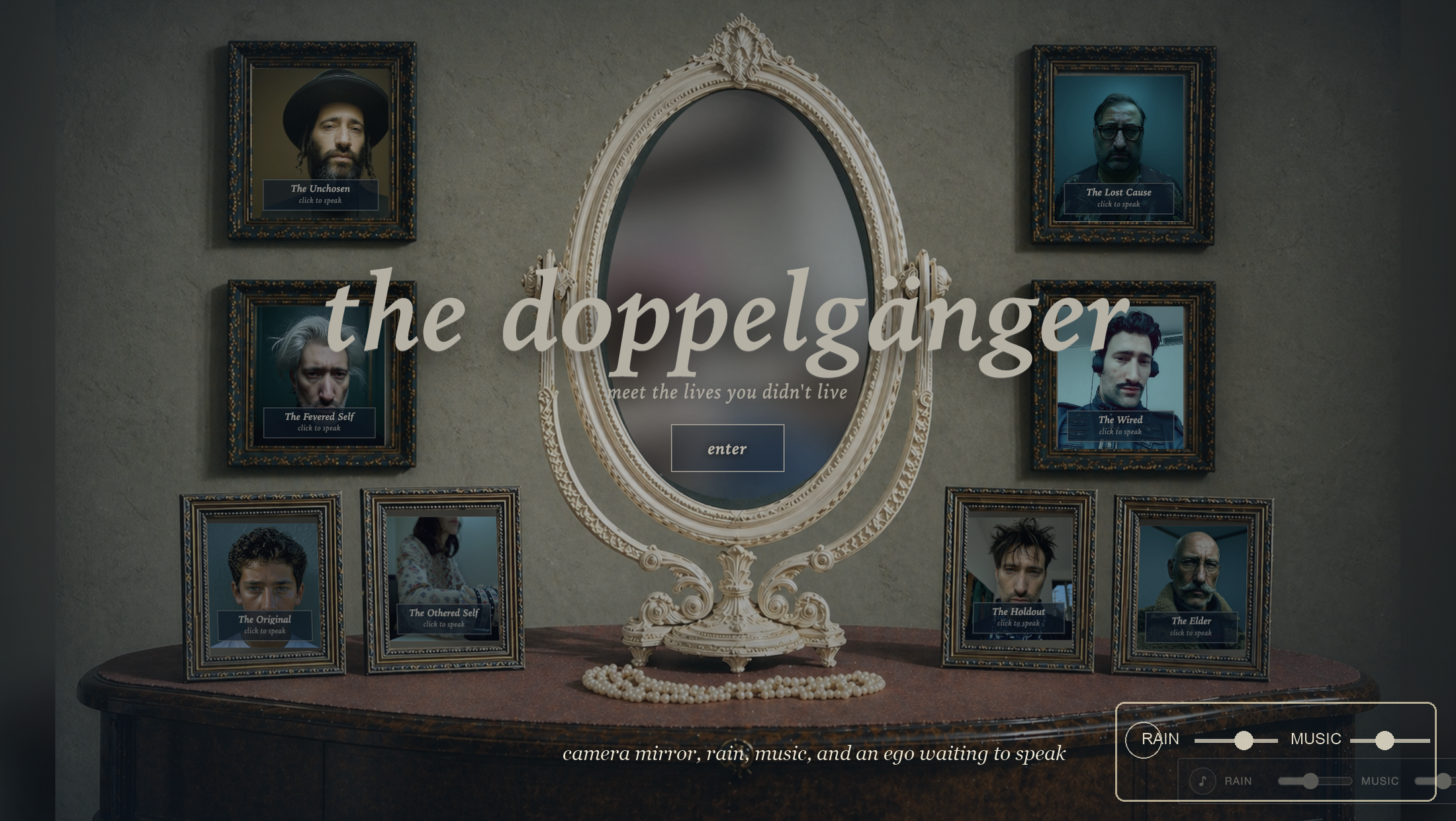
the doppelgangermeet the lives you didn't live
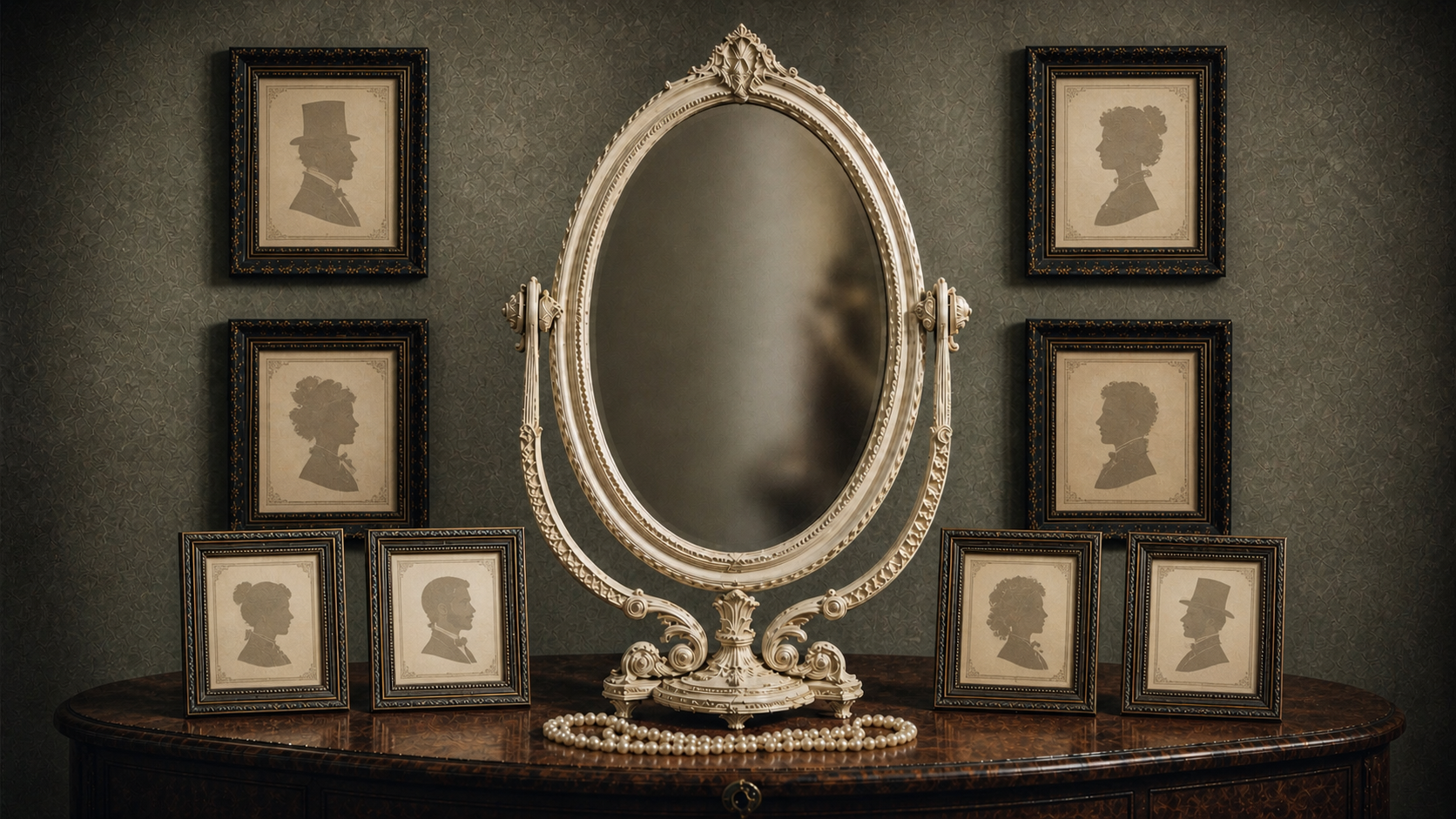
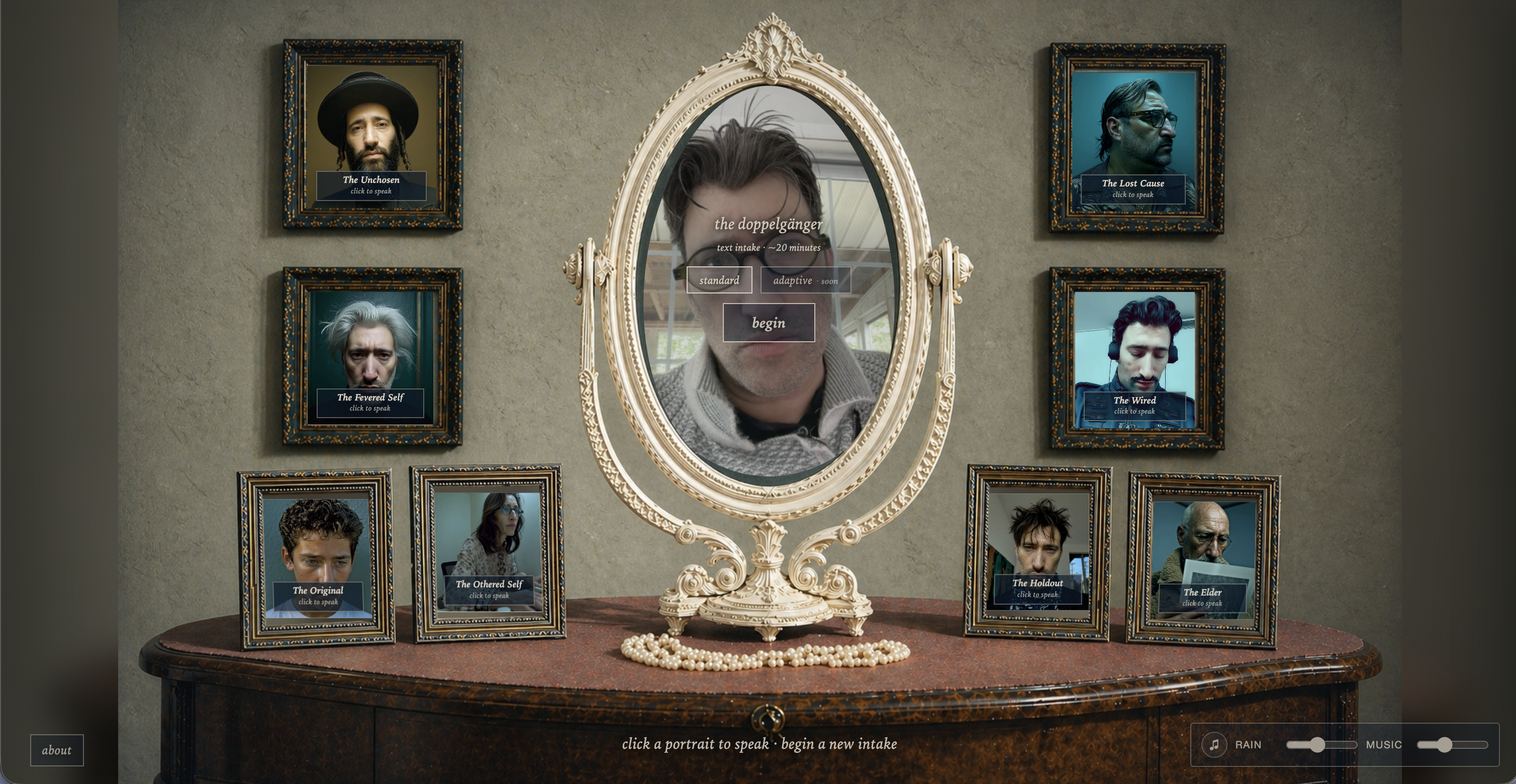
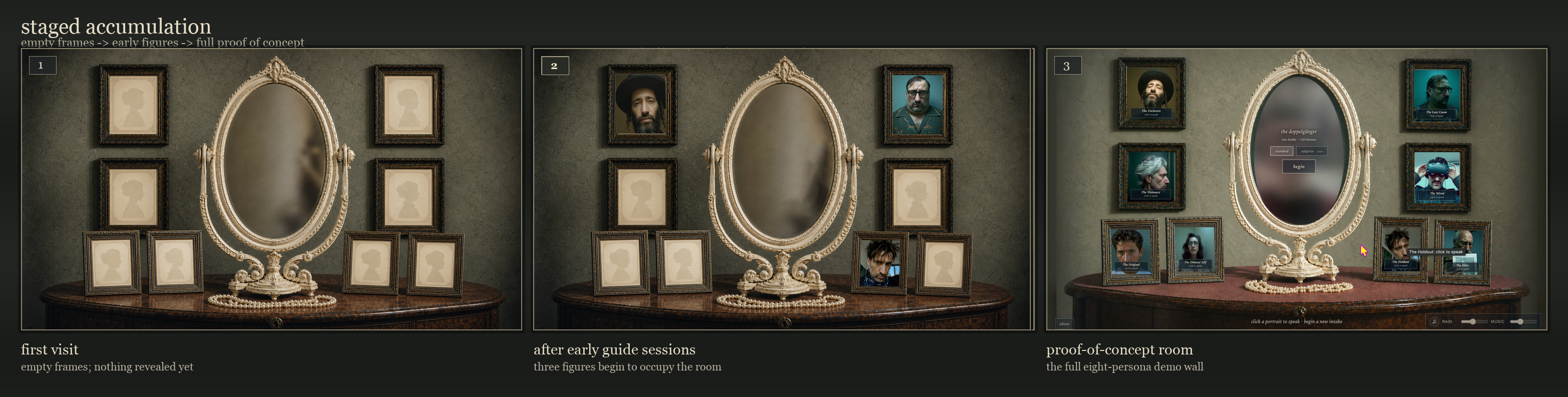
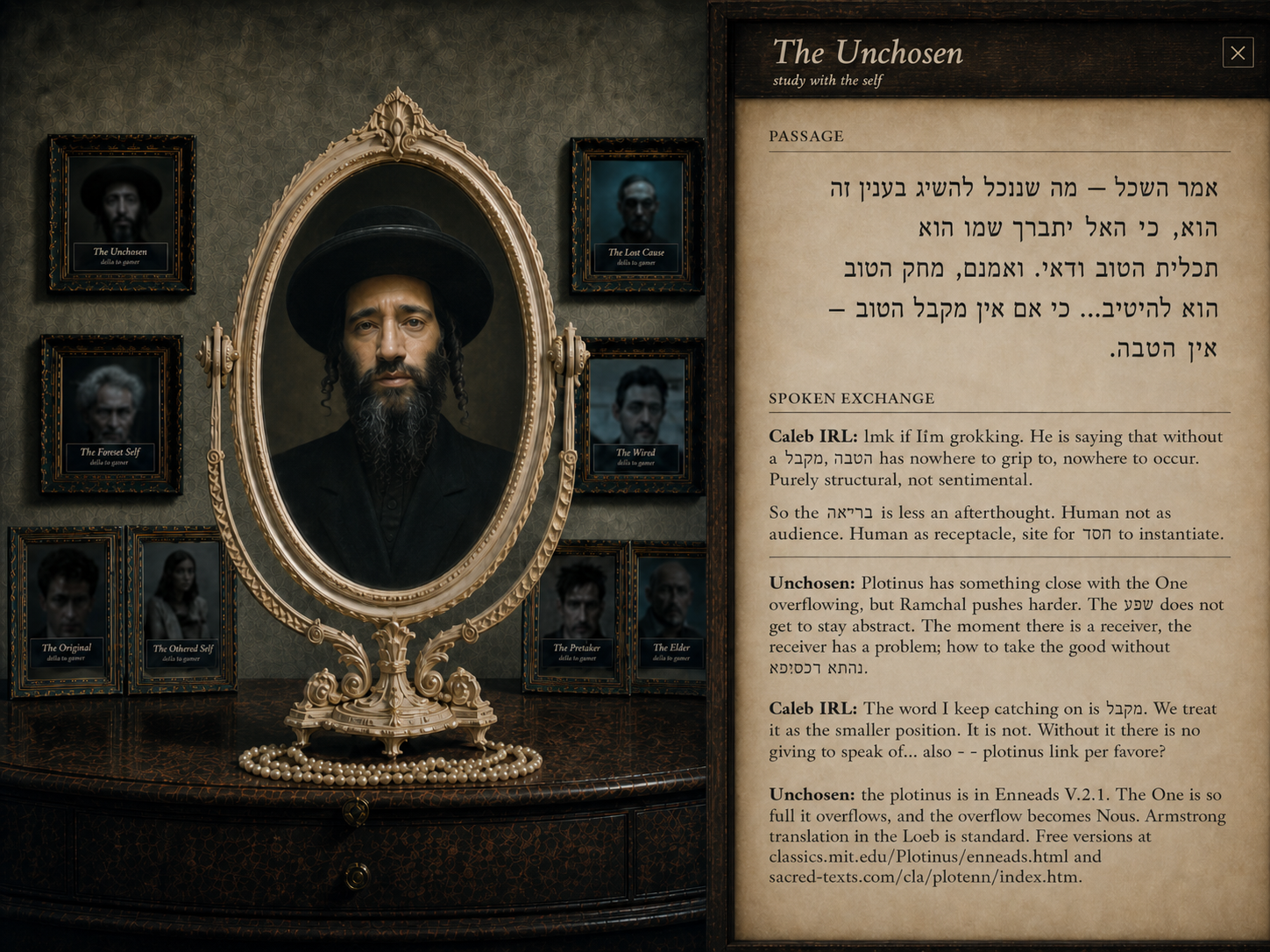
Opening room before intake. The frames are silhouettes; they do not become alter egos until the Guide has enough material to work from.
The Doppelganger is another piece in Hearsay Experiences. Across that collection, users meet custom character engines face to face: voices, responsive personas, and constraints that I author around what each figure knows, wants, misreads, or refuses. The characters are built to improvise, but only inside the reflections, histories, and motives prepared for them.
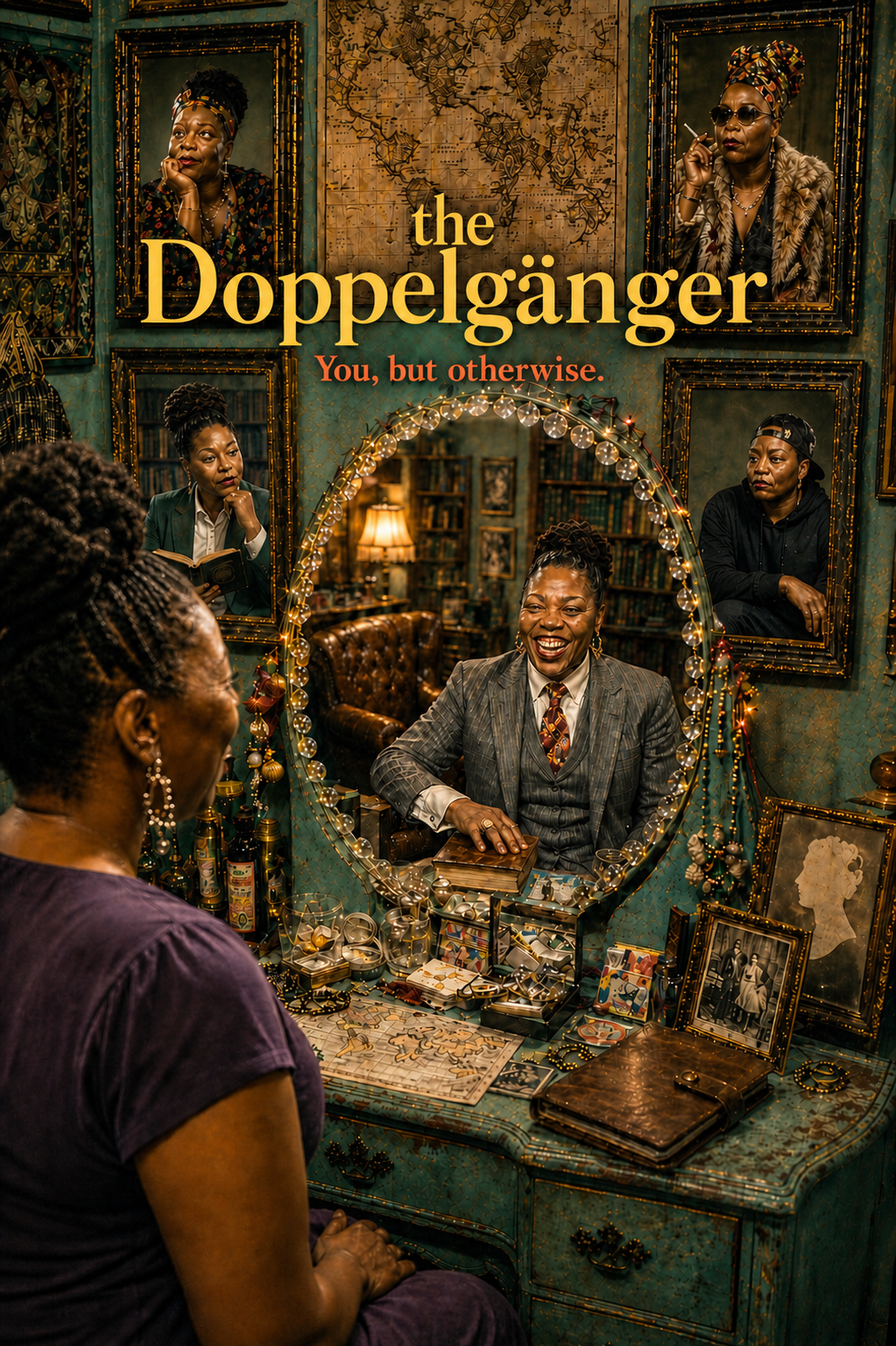
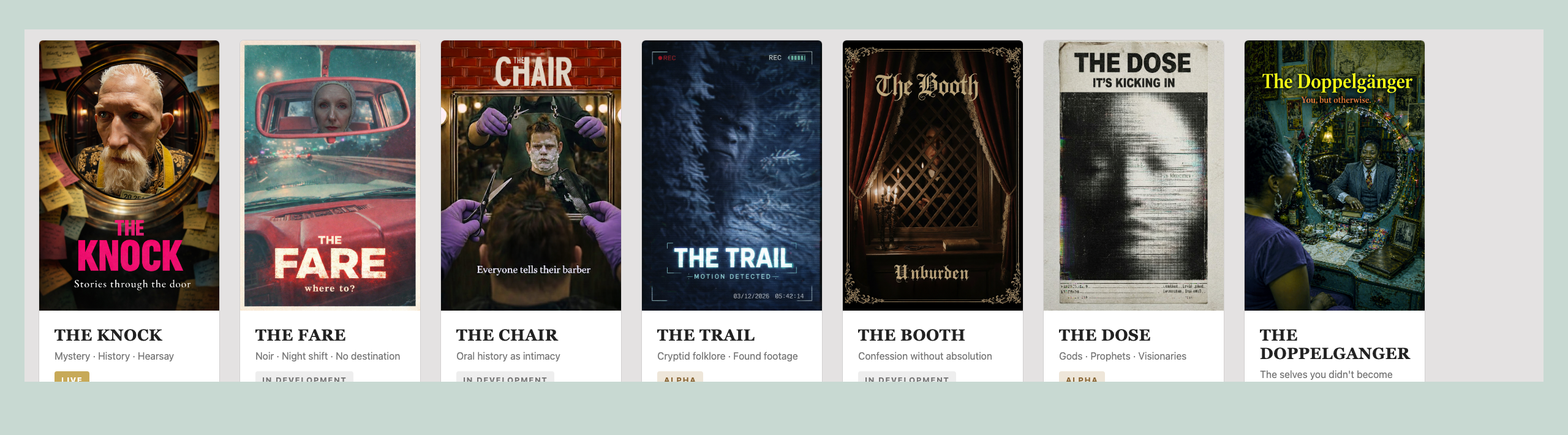
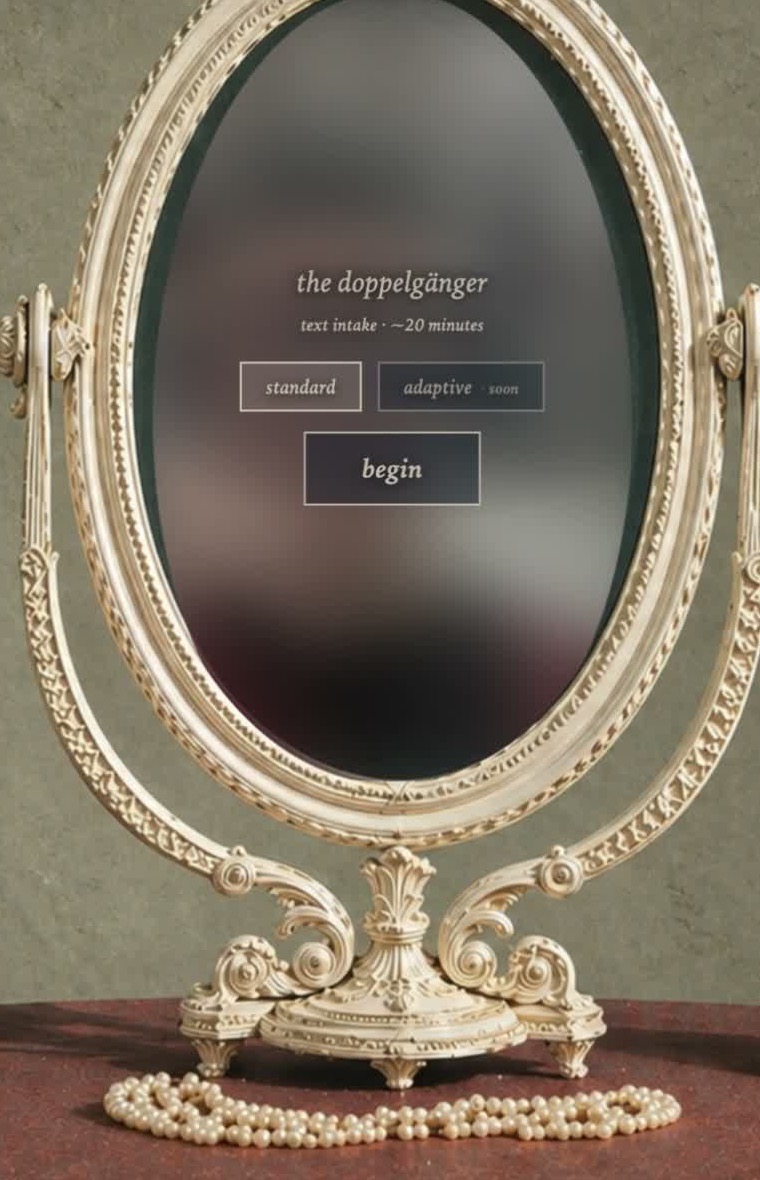
Poster image. The mirror room as a public-facing promise: you, but otherwise.HEARSAY Experiences project list. The Doppelganger appears as one card in the larger collection.
When I paint figures, I try to tease them onto a page or canvas, or out of material, until they seem alive. I do not mean realistic or even naturalistic. I am after a kind of presence, a light in the eyes or a sense that someone is home. There seems to be no shortcut. When it happens, if it happens, shapes and marks and unconscious decisions about color have conspired to suggest an interior life.
The feeling that the figure is looking back at me and thinking alongside me is a fantasy, I know. But it is useful. It drives me from piece to piece and gives me a sense of when something is done. With generative tools came the prospect of a figure that could answer in words.
The plan for The Doppelganger began with a relatively straightforward concept. The user would engage with their alter egos.
The Mirror
Due to current technological constraints, the interactive characters, for the time being, are limited to heads and partial torsos. I have been building each Hearsay experience around a central conceit, a framing device that gives a rationale for why a user might be meeting someone in a way that lets them comfortably see only the face.
In The Knock, the peephole started as a way to leverage that technical limitation, the requirement of a pretext for the face-only encounter, by turning it into a door viewer: a medium for apprehension and misapprehension. The peephole gave that project a way to perform ambiguity. It seemed suited to a piece meant to destabilize the experiencer and buck expectations, a piece in which nothing is fully stable: the game is not quite a game, the author is distributed across prompt, code, interface, and user exchange, the time period and geography are hard to pin down, and the medium itself is unstable. A peephole distorts whatever passes through it, which made it a fitting reference. The slipperiness of the work could be conveyed through the suggestion of the lens.
For The Doppelganger, the framing device is a mirror.
The mirror is familiar enough to be legible at first glance, but it is loaded by the time anyone gets to it. Narcissus mistakes it for another body. Perseus uses it to look without dying. Velazquez and Van Eyck use it to ask who is in the room. Borges and Cocteau do not treat it as a symbol of vanity as much as they present it as a device for splitting the self.
A mirror returns an image that is accurate in one sense and false in another. It reverses the room, flatters when the light is kind, distorts when the angle is wrong, and sometimes makes the viewer look like a stranger.
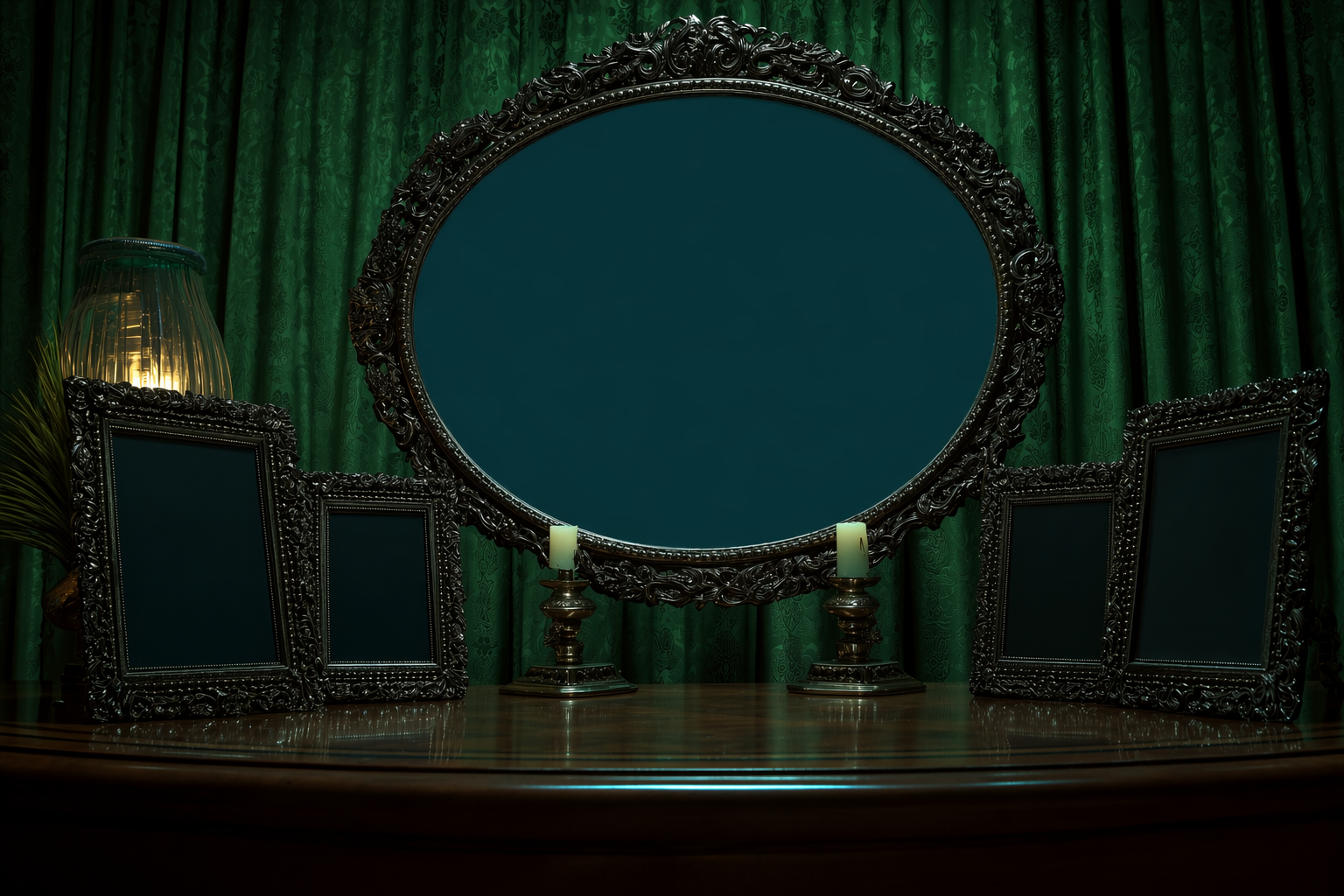
Early room study. This version leaned toward seance: green drapery, candles, and a darker theatrical enclosure. The final room moved toward parlor naturalism instead, still staged, but less occult, more like a domestic apparatus that might plausibly be in a house.
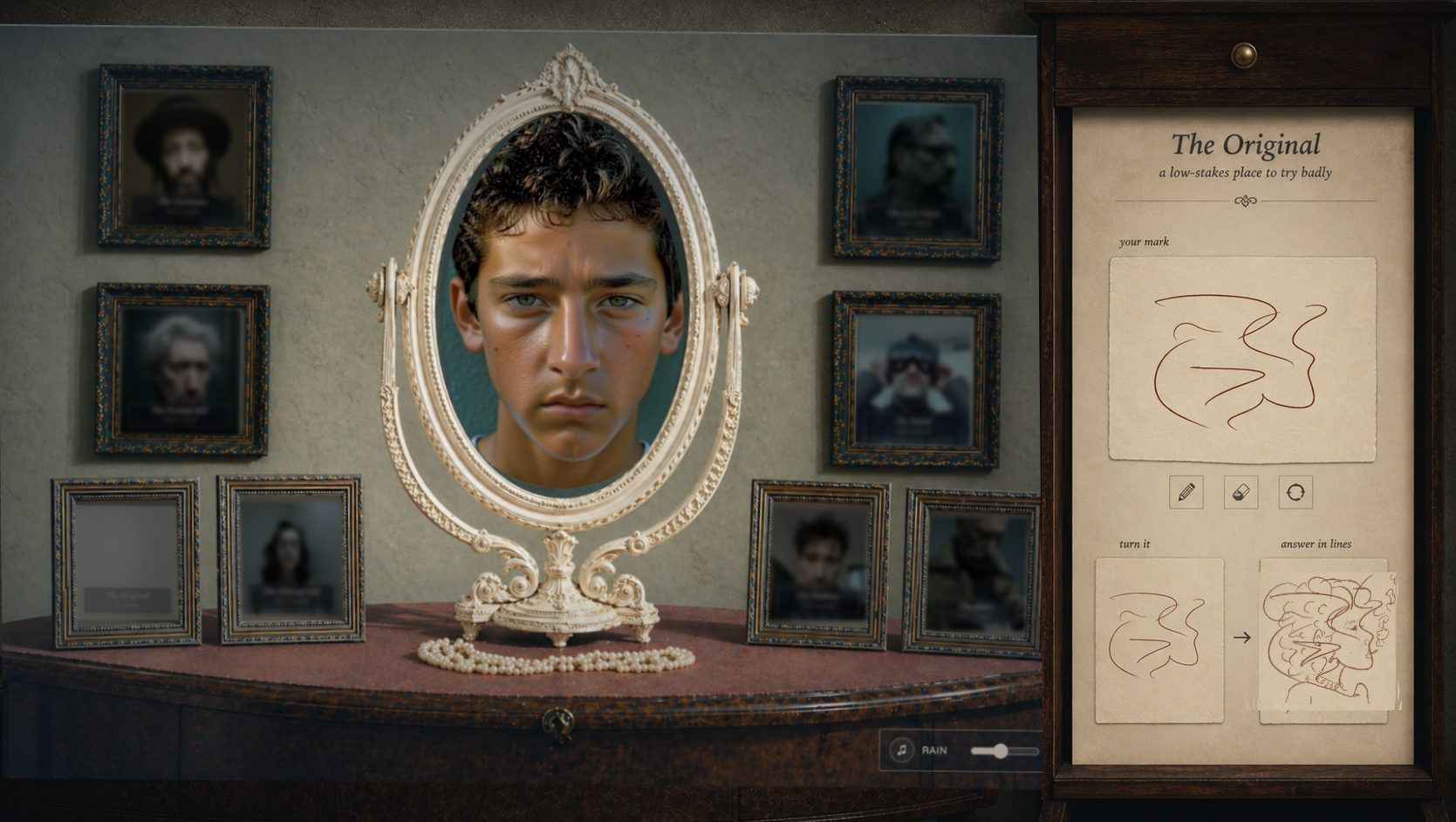
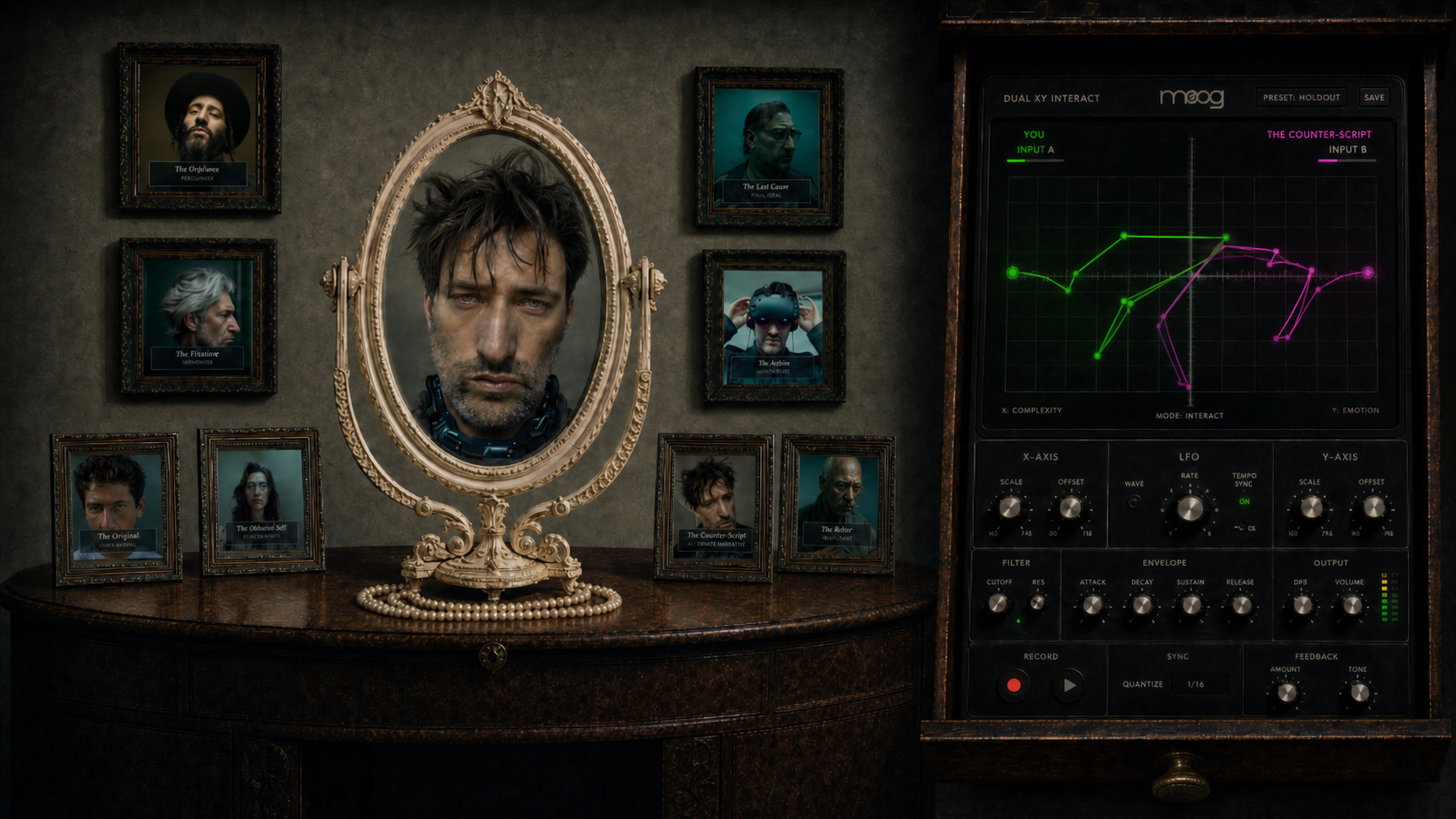
The screen opens onto a frosted mirror surrounded by empty frames. If camera access is granted, the mirror can function as a mirror. The user sees a reflection and can adjust the volume of ambient sounds and background music. The empty frames wait for alter egos to be revealed.
The mirror is an onscreen webcam view that follows the user’s movements. Selecting an alter ego replaces the user’s head in that view with the chosen persona.
There are two primary modes. Both begin with the Enter button. One opens the intake. The other eventually returns to this mirror screen, where the faces and frames carry the results of the prior exchange.
The mirror reflects the user until an alter ego answers.
The Intake
My first thought was novelty. The self as astronaut. The self as cowboy. The self as baseball player. Entertaining variations of oneself. That seemed too thin almost immediately.
I worried that asking the user to volunteer alter egos would produce gimmick. So the intake became the first engine of the piece. It would not be a normal questionnaire. It would be the brain, or at least the logic system, behind the experience.
I gathered material from psychology journals, psychology books, therapeutic tactics, personality frameworks, and related sources. The point was not diagnosis. I was not trying to build a therapist. I wanted the system to be equipped to tease out hopes, abandoned directions, failed trajectories, private fantasies, fears, and things for which the person may not usually have language.
After the intake, the system would identify candidate alter egos. At first I imagined three to six. Over time, three to eight seemed more useful. These personas would typify potential avenues the person could have taken, or tendencies that remain active but are usually folded back into a more socially coherent self.
That was the initial plan. A mirror. An intake process. A wall of possible selves.
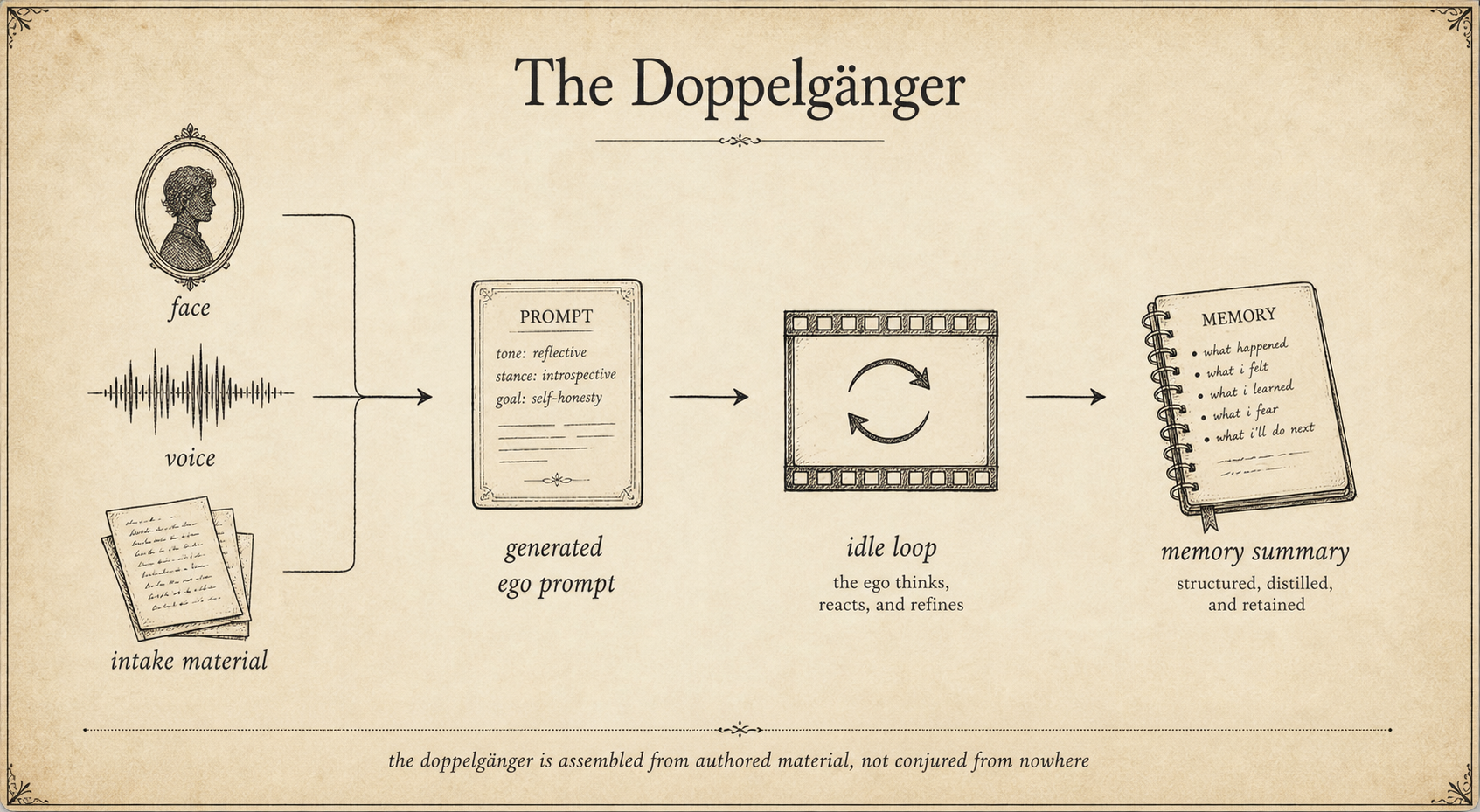
There is also the practical question of how the figures come into being. At the start of the experience, the user is asked to take a photo or upload one, and to permit voice recording during the intake. That material does not produce a finished alter ego on the spot. It feeds several background processes during and after the interview: speech-to-face work, voice cloning, persona conditioning, and the visual variation that turns one face into several possible faces.
All of that takes time. The intake can end before the figures are ready. In the current version, that delay is part of the structure. The user may go about their life until an email or message lets them know that their alter egos have arrived. Or the mirror can remain active. While the faces, voices, clothing, and gestures are being trained in the background, the Guide can continue asking questions and gathering material, deepening and widening the alter egos before they appear.
I assume that window will shrink. The underlying models keep moving in that direction. Later versions may be able to adapt the faces, voices, clothes, animations, and expressive range while the conversation is still unfolding.
The intake begins at the mirror. Standard is the current text interview; adaptive is the second mode, where the questioning changes shape as the answers accumulate.
One of my sons, who is in college, was helping me gather research for the system and helping with folder organization, image editing, and related production work. I said we needed a guinea pig. Someone had to go through the intake so I could get footage of the process.
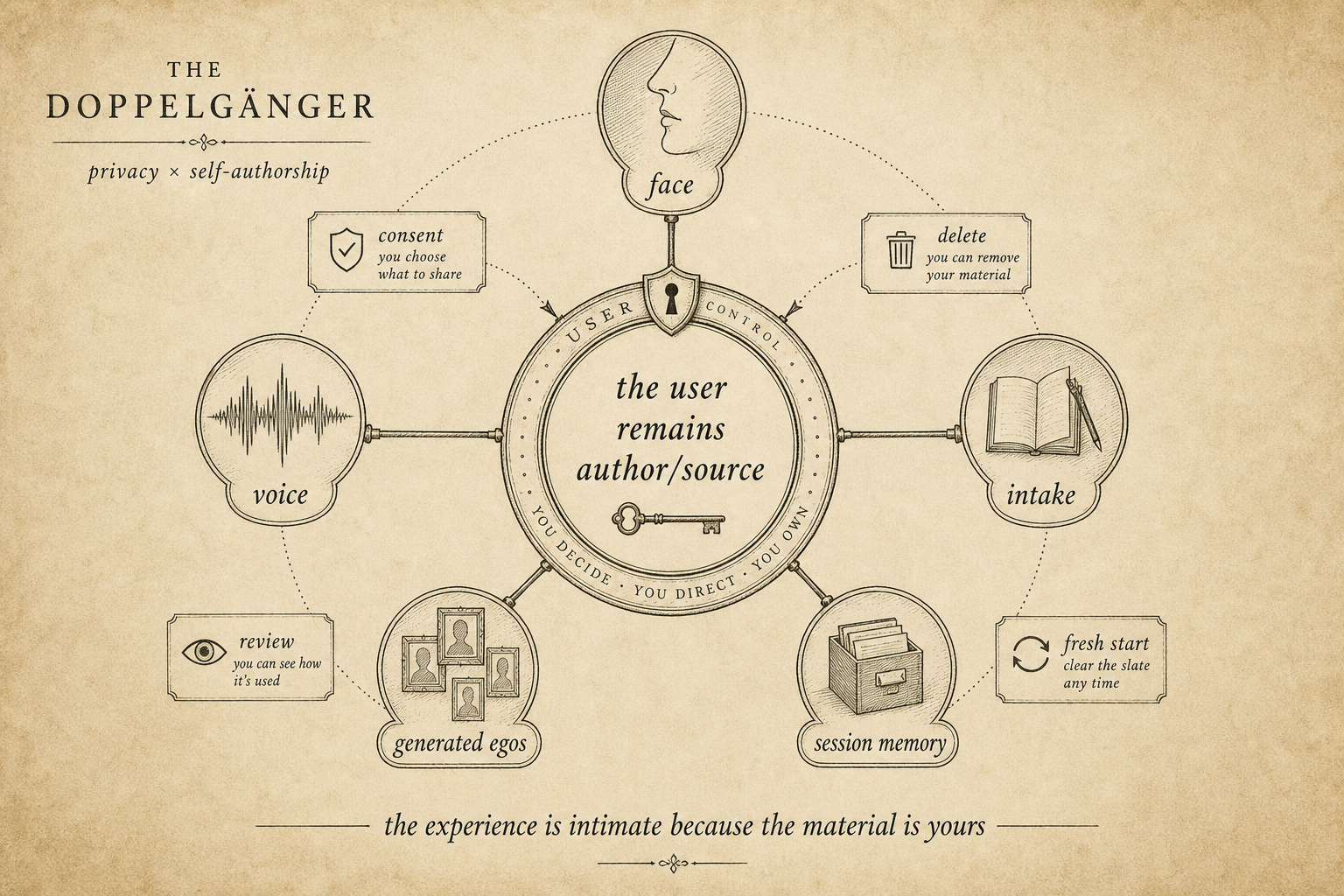
He volunteered. The system was running on my machine and local server, so using his face and voice would not create the same privacy problem as sending that material into a public-facing experiment. He would do the intake, we would generate maybe three versions of him, then film him interacting with them. The fact that I was paying him for the work probably made the prospect more agreeable than pure volunteer duty would have.
I told him it did not even have to be truthful. He could make things up if he wanted. He could say he always wished he had been a basketball player, or whatever. The point was to see whether the mechanism functioned.
When he pulled out at the last moment, I decided to test the intake myself.
I was about to go to the gym. With only ten or twelve questions planned, I thought I could get through them before leaving. My test responses were going to be just as ridiculous: basketball player, pirate, Viking.
Then, just before starting, I wondered if the intake would actually do anything. It was not equivalent to a trained human, obviously. But it had been shaped by a large corpus of writing by trained human experts, and by my decisions about what to ask and what to avoid.
So at the last moment, jacket on, gym bag on my shoulder, leaning on the kitchen table, half out the door, I decided to answer sincerely.
That decision changed the project.
The first interview
I should say plainly that I am not a believer in psychology in any uncomplicated way. I have come to it with suspicion -- psychotherapy first, the field at large after that, psychoanalysis most of all. Of course there are plenty of effective therapists out there. My own encounters have been unfortunate, and left me with the sense that for some inexpert representatives of the field, the practice is something like a soft grift. Listeners getting paid to listen to people whose lives are comfortable enough that the most pressing problem they can find to attend to is themselves. A practice of dwelling on one's own decisions, made available to a privileged caste with no immediate war and no immediate pain to distract them from doing so. I have sometimes wondered whether some of the suffering that goes on in those rooms is concocted in part by the act of having a room available to suffer in.
The one time I went to a psychologist, they did not say much. At one point they said something like "lean into it." Years later, one of my kids saw a therapist for anxiety and heard the same phrase. "Lean into it." If that helps someone, fine. I am not arguing that it never helps. But I have never been especially interested in that mode.
So I went into my own intake skeptical. I thought of the psychological scaffolding of it as a means, a dismissible feature, useful only insofar as it would help me arrive at the alter egos that were the point of the project. I had no expectation that the act of being interviewed would do anything to me.
Ten or fifteen minutes in, I was nearly in tears twice.
The option to create the alter egos appeared after the ten or twelve questions I had set up, but I kept going. I was still talking. I was still interested. I was still volleying questions and answers. Forty-five minutes later, I was shocked by how involved I was.
Of course, everybody is interested in talking about themselves. But the questions were useful, and not because the system was magical. I knew the agenda. I had built the agenda. I knew it was trying to tease out differences, unchosen paths, and internal contradictions. Even knowing how it was made, and what it was trying to do, I found myself answering seriously. Things I had long forgotten surfaced in plain language, even when the line of questioning was not wildly incisive. I was moved. I was pushed to think about decisions I had made, decisions I had not made, and versions of myself that had been abandoned or never fully formed.
Asked what I had needed to turn down in myself to get by, I answered, “I was extremely quiet and withdrawn... I have always had to pretend to be friendly.” I went on to describe a fear of shame and disappointing people, of being seen as a caricature. “But it's not a secret to me.”
In another exchange, I mentioned having been the lead singer and guitarist in bands for years. The interviewer asked about the first time I had sung for anyone.
“When I was a kid I was in a boys' choir, and I was so nervous that, even though I was one of six boys chosen to record the whole album (doubled tracks, etc., to sound like the full choir), I literally mouthed into the mic. I was shy and didn't want to fuck it up.”
“Did anyone notice?”
“The funny thing is I had no idea how studios worked. I didn't realize that the engineer and producer obviously knew.” I remembered singing at full voice in rehearsal, then going silent when the green light came on. “I remember they swapped my mic and stuff... somehow they carried on. I was simply paralyzed. I guess a part of me was trying to make up for that.”
“Did the bands square it?”
“Nope. For sure not.”
I had been afraid of ruining something on which people were spending time and money. The voices of the other boys moved me. I did not trust that I belonged among them. The album was pressed; the tours continued. What persisted was the feeling that I had let down the gods of creativity, the ones that demand that we make things and take risks. That we live rather than die.
Years afterward, through a thousand turns and twists and contortions and modest exposures, I finally took to the stage. I even recorded music, green lights and all.
The shock was manifold. The psychological scaffolding turned out to function as something other than a means to an end. And it stored, or maybe restored, some small portion of my faith in the field. I came out feeling somewhat less dismissive of the luxury of dwelling on one's own decisions. The pursuit may be egocentric by definition, but it is not without use.
The alter ego conversations would prove their own kind of significance later on, but I had not yet reached any of them. I was still in the questionnaire. None of the theatrical part of the project was operating. And by the time I closed the laptop I already had something I had not designed for and had not anticipated.
That is the part to which I keep returning. Not that the experience worked. That something in it had already worked, before the experience proper had begun. And I am not even sure what to attribute it to. Maybe the questions I had built. Maybe the act of being asked questions of a certain kind in private, by something that was not anyone, in conditions where no one was forming an opinion.
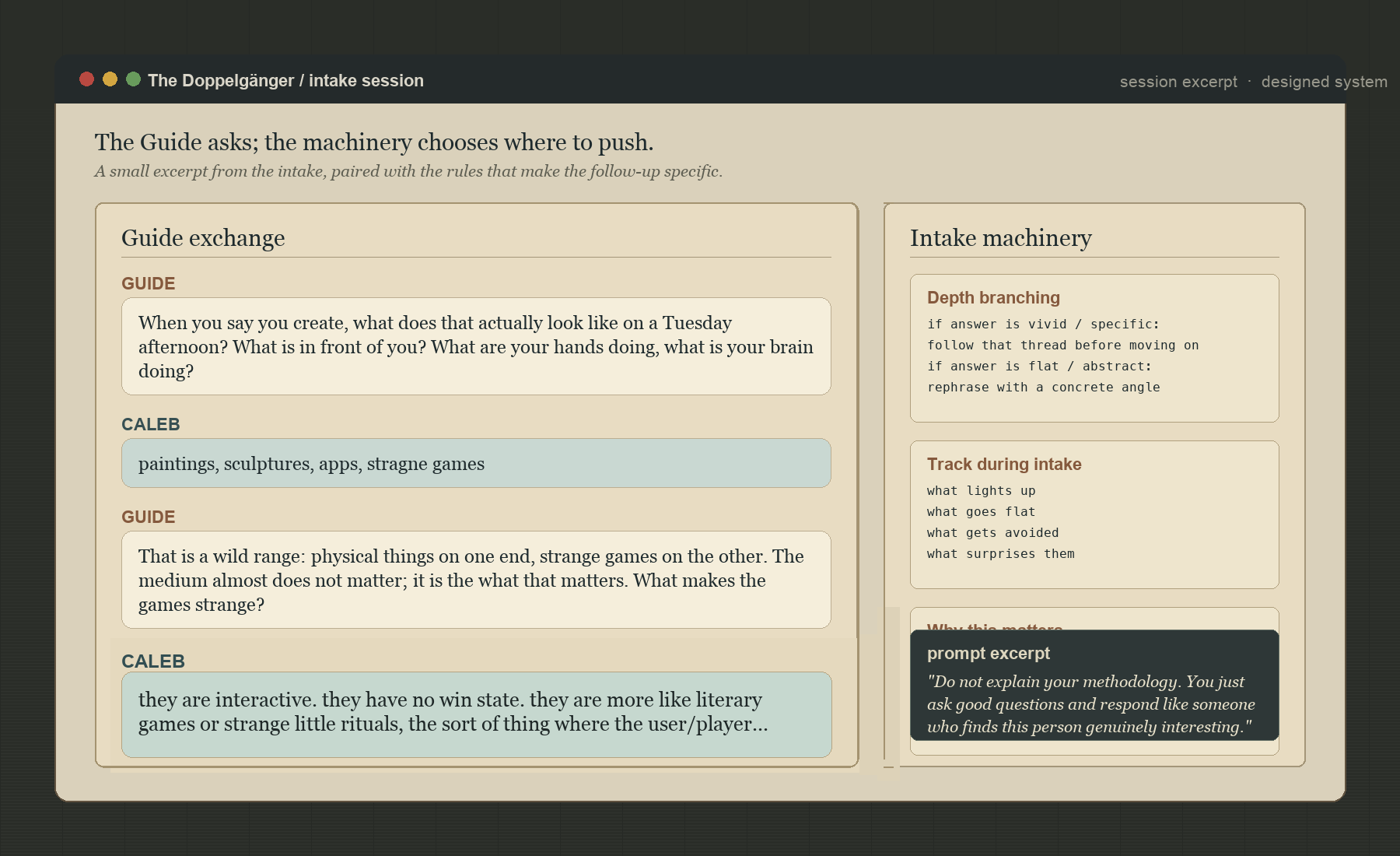
The Guide screen looks personal, but the screenshot shows the apparatus underneath. A designed interview structure, not a supernatural analyst.
One reason it worked, I think, is that I knew it was not a person.
It was not judging me. It did not have a persistent inner life. The conversation would disappear when I closed that instance of the intake document. There was no one on the other side who would think about me later. The interviewer existed only for that period of time. That made it hypothetical and low stakes.
I have had a related experience when working with AI music tools. If I am playing with a band and I do not remember what a B minor seventh chord is, someone might be perfectly nice about it. But I know that in their head they could be thinking, how do you not know this? You have been playing guitar forever.
So I do not ask. Or I do not try something. Or I avoid practicing the solo badly. Or I do not sing the high notes. These are things people often do not do in front of others because they are afraid of judgment, even silent judgment.
With these tools, none of that applies. I can say something dumb. I can misspell. I can try a ridiculous direction. I can volley language, music, ideas, and mistakes back and forth.
Because of that, I tend to be more experimental. I take more risks. I move more quickly. I sometimes develop more because I am not hampered by the concern that the idea will collapse in front of someone else.
That observation became central to The Doppelganger.
As in the previous entry, I have been thinking about these tools less as a single instrument than as a set of collaborators, or maybe a set of partial collaborators. The exchange does not always look like a clean prompt followed by a clean answer. Sometimes a change happens in the code after barely any discussion and is absorbed into the system. More often, the exchange moves through plain language, screenshots, handwriting, arrows, typed notes, and whatever else seems likely to make the problem legible.
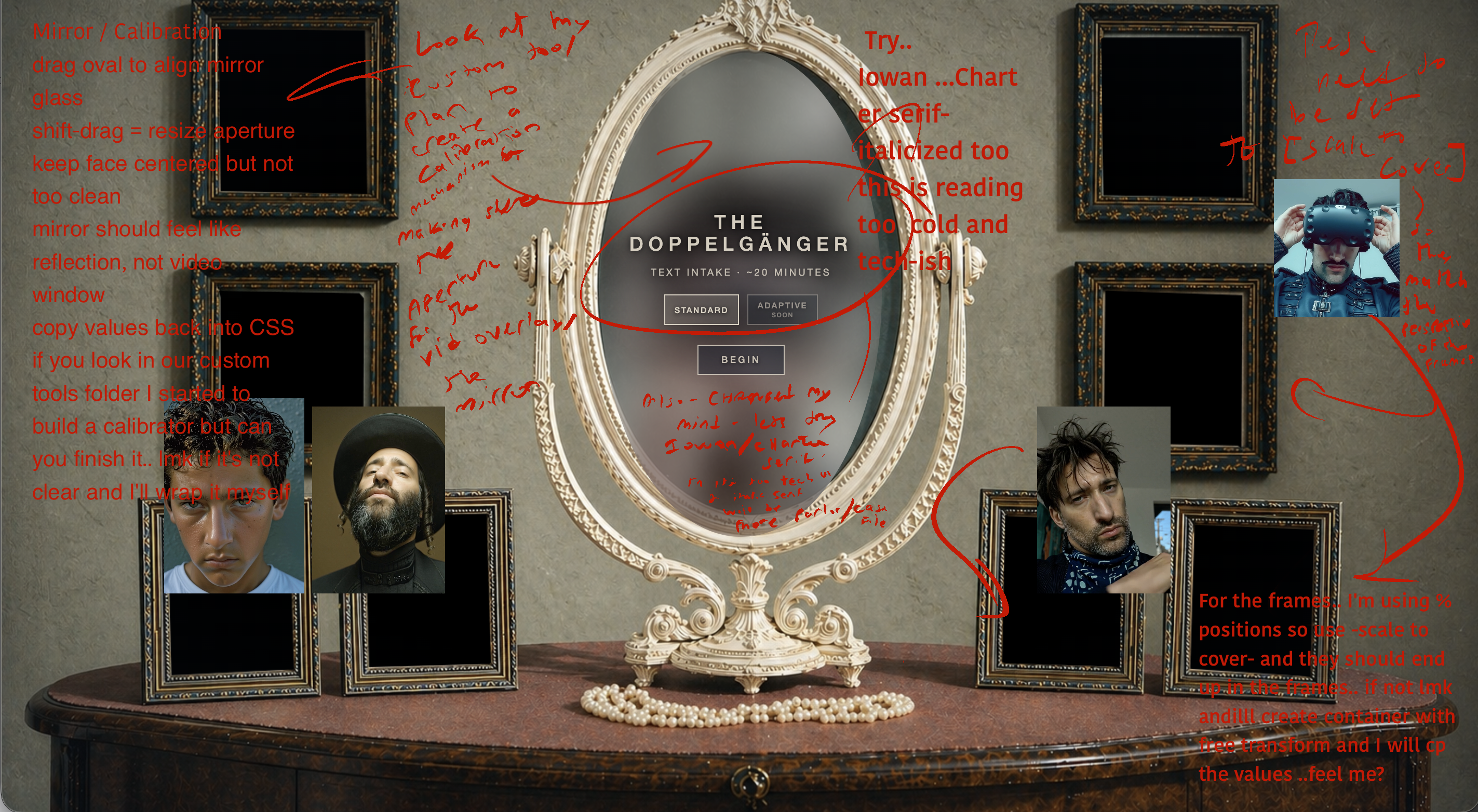
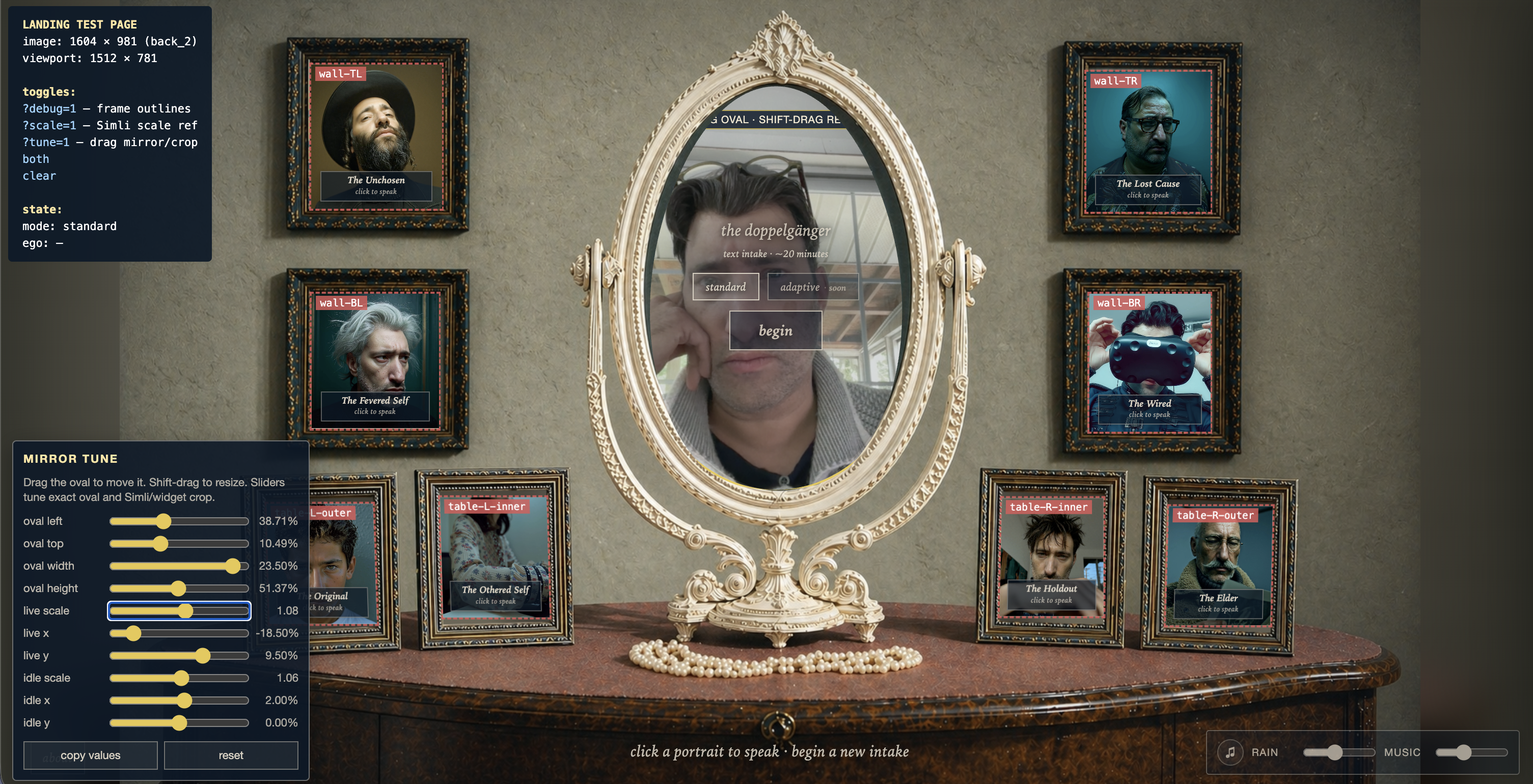
The image below is not unique, but I happened to save it. It shows a marked-up screenshot of the opening screen during the period when the live camera view was not yet fitting correctly inside the mirror. The oval crop was meant to act as the user's reflection, but at that point the ellipse was not fully matching the mirror frame built into the background image. So the conversation became visual: this shape, this frame, this much slippage, this much correction. The agent had to read the picture, parse the notes, and turn the mismatch into code.
Annotated build note. In this exchange I am conveying typography adjustments, font rationale, and guidance on building a custom calibration tool to fix the alignment problem of getting the live video to fit inside the oval mirror frame.Calibration pass. A temporary tool with sliders and frame guides appears over the room long enough to align the mirror, live camera crop, and portrait frames.
The calibrator shown here is a temporary tool, something that exists only as long as I need it to exist. It lets me move the mirror glass, live camera crop, and portrait frames visually, instead of guessing values through trial and error inside the HTML and CSS. Once the alignment works, the values are copied back into the code and the tool disappears from the public surface.
The Guide
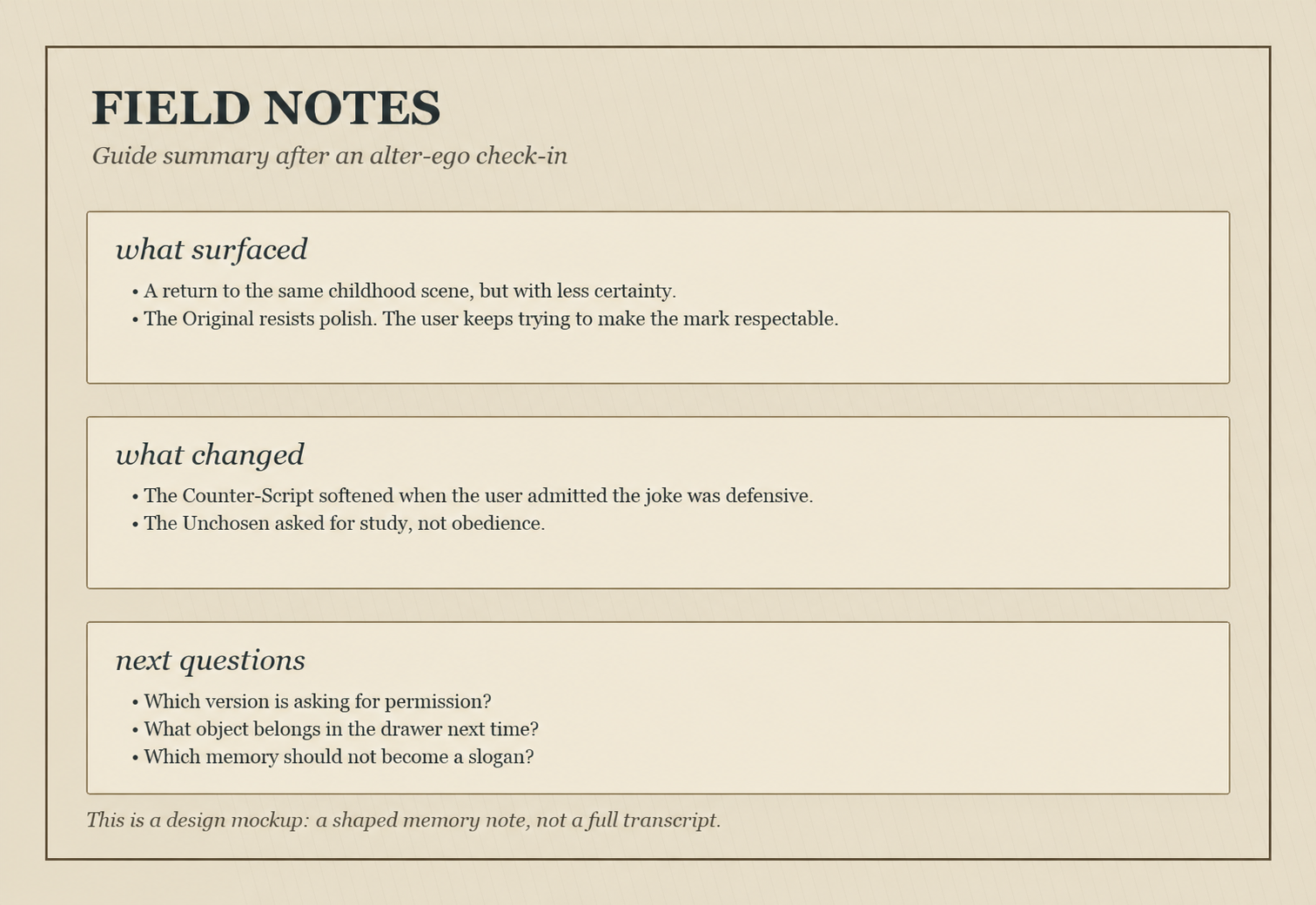
After the intake, I went back and developed the listener into something with a longer life than a single questionnaire. I started calling that character the Guide. Not a therapist. Not an analyst either, really. A reader with a tone, and a way to return. The Guide conducts the initial intake, but I want them to come back as well. Between conversations with the alter egos, the Guide checks in. They ask what remains from the last exchange. They tease out a finding the user did not quite reach the first time around. They keep the work moving without forcing the user to declare anything finished. They also continue to develop the alter egos. The four core figures that emerge from the initial intake are a starting set, not a final cast. If the conversations with the user warrant it, the Guide can add to that set, retire one, sharpen another, or quietly let one recede to the edge of the room.
Memory As Structure
The experience could move in at least two directions.
The first is the more structured one. The Guide begins to develop a few core alter egos. Maybe it starts with three or four. They will not be wildly robust at first, because a user is not going to talk to the intake system for fifty hours. But even in a forty-five-minute conversation, there can be enough material to tease out several versions.
In the background, the system translates what the person has said into characters. The Guide can return in later conversations and ask about one persona or another. Those later visits add memory, texture, and specificity. The system might learn more about a failed direction, the fantasy behind it, the fear underneath it, or the memory attached to it.
The alter egos become more developed through repeated encounters.
Three room states: no figures, early figures, and the fuller cast. The mirror begins empty, then starts to acquire a history.
This is the point at which persistent memory stopped being an engineering convenience and became central to the idea. I did not want the characters to wake up every time as if nothing had happened. I wanted the mirror to keep score, but not in a game sense. More like residue. What had been admitted. What had been avoided. Which persona had become sharper. Which one had started to feel false.
That insistence changed the technical path. The live conversation, the intake material, the persona descriptions, and the summaries cannot be treated as disposable chat history. They have to become a continuity layer. Not a transcript dump, not a surveillance archive. A shaped memory that can be called back without turning the piece into a diary app.
The same Guide voice that opens the session also closes it. Not with a diagnosis ("you are resolved"). More like a stated leaving, what I came for, I think you've given me, that hands the experience back to the user without claiming resolution. The bookending is intentional. The figure who started the session does not vanish when the alter egos take over. The user leaves, and that leaving is part of what the mirror remembers next time.
The continuity layer behind the mirror. Face, voice, intake, prompt, idle loop, memory.
There is no conventional win state. But there is something like one, if that word even applies. The movement is toward integration. The experience externalizes parts of the self, not as multiple personalities, but as exaggerated or clarified tendencies that are already there. The user sees those parts at the limit, talks to them, and gradually has to deal with them again.
The figures in this case-study version are mine. They are not the default cast. Another user would get another set, because the Guide is meant to draw from the intake material, not from a fixed menu of archetypes.
In trying to understand why the system established one persona rather than another, some figures were predictable and some were not. Even when a figure made sense to me right away, the conversations sometimes drew a line between things I had mentioned only in passing, or treated as unrelated.
The Unchosen was not a shock. As a teenager, I had moved toward Orthodoxy partly out of a sense of debt to relatives and ancestors killed in the camps in Europe. Some childish moral arithmetic told me that if I did not take up the laws and rituals, I was helping finish the erasure. Most of that devotion was ritualistic, academic, and cold. Later, after college and before graduate school, I spent time in ultra-Orthodox communities and came close to a Chassidic life. It would have reorganized my days, my geography, my obligations, and almost certainly the space available for painting and other pursuits.
“I might have been a near-Chassid at one point,” I told the interviewer, referring to a strictly observant Jewish life. “Became Orthodox at around eleven, was in a Modern Orthodox community, studied in Israel after high school.” When asked whose decision that had been, I described my mother's search and my stepfather's return to observance. “She has one of those bright, generous souls, and I could feel her willing us all there.”
The intake Guide also caught a defeatist current I have spent a long time trying to keep at bay. There were years of factory work, truck driving, part-time teaching, and odd jobs when it seemed plausible that I might disappear into a cycle of self-loathing and resignation. Those parts of the conversation no doubt sowed the seeds for The Lost Cause.
The Counter-Script seems to have come from answers about traits I admire and do not always trust in myself: decisiveness, directness, less effusiveness, more reliance on impulse, less concern over how a choice might be received. The figure works less like a diagnosis than a tendency given a face.
The Unchosen.The Lost Cause.The Counter-Script.The Wired.The Othered Self.The Elder.
Conversation test with The Unchosen, The Lost Cause, and The Counter-Script.The Foreman, a back-burner figure. Too close to The Lost Cause to claim a separate frame for now, but still part of the pressure around labor, resignation, steadiness, and suspicion of artistic striving.
The Sensorial Part
Just as with The Knock, there is a sensory layer to The Doppelganger. The mirror, the ambient sound, the background music, the shallow reflection, the surrounding frames, and the delay before a figure answers help the screen keep the fiction legible while the machinery underneath handles the technical work.
The interface still has to be usable, but it also has to acknowledge the strangeness of the exchange: a person looking at a face made from, or adjacent to, their own face, and hearing a voice shaped by what they have disclosed.
The room is built as atmosphere: mirror, ambient sound, background music, a waiting figure, and the slight delay before the exchange begins.
Dorian Mode
The second direction is what I have been calling Dorian mode, after Oscar Wilde's Dorian Gray, whose portrait changes in response to the life its subject refuses to show on his own face. I do not mean Dorian in the sense that the project has to become dark or corrupted. I mean that the image changes as the conversation changes.
The user begins by looking more or less like themselves, maybe based on a screenshot or captured image. As the person talks, the figure begins to evolve. In some future version with more computing power and more real-time image generation, the change could happen during the conversation itself. The face could phase in and out of alternate identities as the subject shifts.
During one conversation with the Guide, I started remembering theater productions I had been in, especially the strange split between panic and fluency. Some memories were all anxiety: having to recall lines, catch a cue, and shape a delivery in exactly the right way. Others were almost the opposite. The memorized language would spill out as if I were thinking it in real time. In the future version I am describing, that sliding emotional spectrum could become visible in the figure in the mirror. The face might tighten, soften, perform, or lose the performance as the conversation moved through those memories.
More realistically, for now, the visual training would happen in phases. The user would talk to a character. The next time they returned, the figure might have changed based on the last conversation. It could become a hybrid. In my case, maybe a bearded version with a guitar strap, a short-sleeve shirt, and a tattoo. Or if the conversation had pulled strongly toward one avenue, the next version might simply look older, more severe, more religious, more theatrical, more defeated, more stylish, more sealed off.
The mirror would become a record of conversational divergence.
Shots from Adaptive mode, Dorian mode in shorthand, loosely inspired by the painting in The Picture of Dorian Gray that alters in response to the moral life of its subject. For now the transformation between alter egos and personas happens between sessions, not within them. As compute and environmental costs come down, it will move into the conversation itself and evolve in real time.
The Activity Drawer
I am interested in objects as fetish, but not as a lurid thing and not as a symbol pasted onto the project. I mean a site, a form that gathers charge because it has been handled, needed, returned to. In The Knock, the sensory packs were designed to activate that charge, to make the digital encounter leak into the room and intimately engage the viewer. A matchbook, a note, a scent, a little packet of evidence. The object as a means for the fiction to touch the body.
The Doppelganger has a related instinct. The mirror image is obviously charged, but the other object is an activity drawer: a top-down viewer that can slide into the screen like a shallow compartment of paper, tools, small instruments, notes, and odd keepsakes. It is not a literal drawer sitting beside the mirror, and not a menu pretending to be furniture. It is the place where the screen can offer a shared object.
In ordinary use, the drawer might open as a general viewer: a spread of things that have begun to belong to the user and to particular figures. Selecting one item opens the surface attached to it. At other times, an alter ego can call the drawer directly. The Original, a younger version of the self, suspicious of polish and machinery, asks to draw, so the sketchbook opens. The Unchosen asks to study, so the text surface appears. The Counter-Script proposes a musical exchange, so the synth opens. Under the hood these are separate small applications, but they are meant to feel like objects pulled from the same compartment.
At this point in my version, only three of those surfaces exist as working features. There are traces in the code and notes toward others, but the project is not trying to become a collection of games. The activities are supposed to appear over time, as the system comes to understand the current user, the alter ego, and the common ground between them.
That younger figure might open a sketch panel. Sometimes it is a scribble game where neither participant lifts the pencil more than once per turn. Sometimes it is exquisite corpse, played fast, where the figure completes a body or a landscape on a fold the user cannot see. Sometimes it is a finish-the-mark exercise: one of us makes an amorphous squiggle for the other to turn into something. The child completes it, ruins it, misunderstands it, improves it, or turns it into something the user did not intend. Then the user responds. A low-stakes drawing game, but also a conversation with the part of oneself that still wants to make marks before they are good.
The Original sketch panel. A crude mark becomes a small exchange. Scribble game, exquisite corpse, or some other improvised drawing prompt.
The exchange in the other direction: I hand The Original a mark, and it returns a cup.Another pass from my case-study version. The starting lines stay visible, but the figure answers them as a face.
The interviewer also asked whether, as a child, I had refused to do something for which everyone else was being praised. I recalled a birthday party at a chocolate shop.
“I remember being offended, hurt, proper hurt, at a birthday party. All of the kids were using molds to make chocolate whatnots, and I was making some horrid sculpted chocolate thing. A dragon or something, not sure, but I basically refused to use the dumb molds. The other kids got accolades, and truly, in my gut (not a learned instinct), I thought: wtf, they are literally pouring shit in a mold... not creating. not art.”
Asked what that child would make of my current work, I answered, “I have drifted very, very far. In fact, you are my creation... AI, LLMs, fine-tuned LLMs, etc. Long story, but I am no longer a Luddite... or a purist... it's confusing.”
“Would he recognize it, or feel sold out?” the interviewer asked.
“Man, that really is the question,” I answered. “I'm really not sure. I think, I hope, I may be using some molds here and there but then bending them back toward dragons... as in messing with them.”
Looking back at that exchange, I think the memory had been buried for a long time. I recognize in it a preference I still feel deeply for things that are made and wonky, felt and lived in, resistant to a program or a preconceived result. A taste for improvisation, even -- or especially -- when the result is a bit broken and unrefined, battered and unlovely.
I also remember being yelled at by someone who seemed to have authority. It might have been a parent or an employee of the chocolate shop, perhaps a teenager for all I know. They seemed annoyed, even disturbed, that I was refusing to use the mold and make something nice and presentable. I remember feeling wounded, surprised, insulted. Scandalized.
I am still smarting.
For The Unchosen, I added a panel modeled on chevrusah, the Jewish practice of studying and debating a religious text with a partner. A passage is reproduced on screen in its original language. My alter ego and I can annotate the text and discuss it aloud or through a written chat. The silent option lets me use the panel in a library or an office building, someplace where it would be inappropriate to yammer at a person on my computer, real or conjured.
The text might be from Pirkei Avot, a collection of rabbinic teachings, or a fragment of a siddur, a Jewish prayer book. I imagined an encounter that was half study and half confrontation: reading with a figure who represented an abandoned path.
In a saved example, we are considering a passage about giving and receiving. I ask about the receiver, a position I have been treating as the smaller one. The figure refers me to the ancient Greek philosopher Plotinus. My next request is for the source. Familiar habits of reading persist, even with this particular study partner.
The Unchosen study surface in a hybrid session. The exchange can happen aloud, in writing, or both; the side panel also works as a text-chat surface.
The Counter-Script's drawer is imagined less as a song generator than as a shared electronic instrument. The user and alter ego can lock into a scale, tempo, or tonal field, then take turns setting up small repeating patterns. One side establishes a phrase; the other answers, interrupts, or mutates it. The point is not polished AI music, but a playable argument, a duet in which the alter ego pushes against the user's first instinct, making the sound rougher, stranger, or more varied. Because the interaction is native to the screen, it feels closer to a small synth or Animoog-like surface than to a conventional band simulation.
A shared synth drawer: the user and The Counter-Script trade patterns inside a locked scale.
The side panel lets an alter ego invite the user into the kind of activity that would make sense for that self. Drawing. Text. Sound. Memory. Each one a different way of touching the mirror.
Field notes
I have been thinking about what the user is supposed to take away at the end of a session. The Knock produces a book, eventually. A published artifact built from the manuscript the engine has been generating in the background of the conversations. The Doppelganger does not want a book. The conversations are not story. They are reflective, and a novel of one's own intake would read as confessional. Confession is not what this is.
The objects the encounter leaves behind, or pretends to leave behind, are quieter. The sketch surface. The chevrusah page. The lyric notebook. The chord sheet. The intake transcript. The framed face that keeps looking after the conversation ends. These are not props exactly. The project is not trying to produce a clean psychological profile. It is trying to make an object out of encounter. A face, a voice, a memory trace, a frame, a page, a side panel. Something the user can return to and mistrust a little.
The shape I have been thinking about is closer to a case file. The Guide, the same temporary listener who conducted the intake, sets down a short document at the end of the session. Three layers. A few sentences per alter ego on what that figure said and what it pointed toward. A small recommendation grounded in something the user actually told the Guide. Not a horoscope. Not a self-help precept. Closer to: after your conversation with the Counter-Script, where you described turning down the gallery offer, do not be quite so quick to apologize preemptively. Trust the decision. Also, play guitar for an hour this week. And one or two sealed-letter prompts of the kind a doctor's office tucks into your folder, to be revisited in two weeks.
It is not therapy. It does not pretend to be. The format mirrors a clinical practice, where the listener's private notes become the part the patient is permitted to read, while the surrounding interface keeps to the parlor atmosphere the project has committed to. The Guide is a careful reader, and the document is what they read.
That artifact may end up being more important than the alter egos themselves. The egos provide the theater, but the notes are what remain after the room goes dark.
Field notes printout. The take-home document in a case-file mode, not a diary and not a book.
Privacy And The Case Study
I was comfortable using my face and voice in a local test setup on a small server. The version I would need for a wider release would send requests to AI models on remote servers. Participants would have to supply images and record their voices to generate the likenesses and alternate versions. Their intake answers would also be processed by those services. I was not interested in taking on that privacy gauntlet. The project became more of a proof of concept. The case study uses me. Another participant’s intake would yield a different cast.
The alternate versions develop from a base portrait, a base voice, and the intake material. They can differ in clothing, physiognomy, age, posture, expression, accent, and other traits. Using myself lets me test those changes without asking someone else to provide such intimate material.
Privacy and self-authorship diagram. This case-study version uses my face and voice because the materials are too intimate to borrow casually.
In the intended system, another participant would also have different drawer activities. Small applications would be generated as the conversations developed, with their logic shaped by that person’s exchanges. The activities shown here were developed from my intake. They are examples of what the system could make for a given persona.
The mirror project began as a way to make a user talk to alter egos. The most powerful encounter may happen before the faces appear, before the theatrical layer even begins. An interviewer who is temporary, nonhuman, and low stakes can invite a kind of disclosure that would be difficult with another person in the room.
The alter egos are still the visible part. They give the experience its form. But the machinery is the moment when a user realizes they are saying things they did not expect to say, because the listener is not quite a listener.